How Play-Based Fitness Improves Kids Health and Performance
 Reading Time: 8 minutes
 Play-based fitness for kids offers opportunities to practice movement without making every activity feel like a formal workout.
Children have this amazing natural urge to learn and explore, and they usually do it best through play.
This isn’t just about having fun; it’s a super powerful way they grow, shaping everything from how they get along with others to how well they move their bodies.
When we bring this idea into physical activity, we find a better, more enjoyable way for kids to get fit.
Instead of seeing exercise as a chore, play-based fitness makes it feel like an adventure. This gets kids more involved and gives them deeper, lasting benefits for their athletic performance and overall well-being.

This approach goes far beyond strict drills and instead embraces activities that kids naturally love.
Think about games of tag, climbing trees, or tackling an obstacle course.
These aren’t just random fun; they’re actually complex exercises that build strength, agility, and resilience in ways traditional workouts often can’t.
By tapping into the power of play, we can help children build a positive relationship with fitness that lasts a lifetime.
As a professional basketball player and father, I see value in giving children room to enjoy movement before focusing heavily on performance.
My priority is to encourage curiosity, participation, and progress at a pace that suits the child.
Research also supports the idea that active play can support the physical activity children need for muscular fitness, cardiovascular health, and brain health (Centers for Disease Control and Prevention [CDC], 2026).
It also belongs within an overall positive approach to children’s health and fitness that includes proper nutrition, adequate sleep, and supportive relationships.
What Is Play-Based Fitness for Kids?
Play-based fitness for kids uses enjoyable movement activities to give children opportunities to develop physical skills.
It can include child-directed free play, adult-guided games, or organized sessions with a playful format.
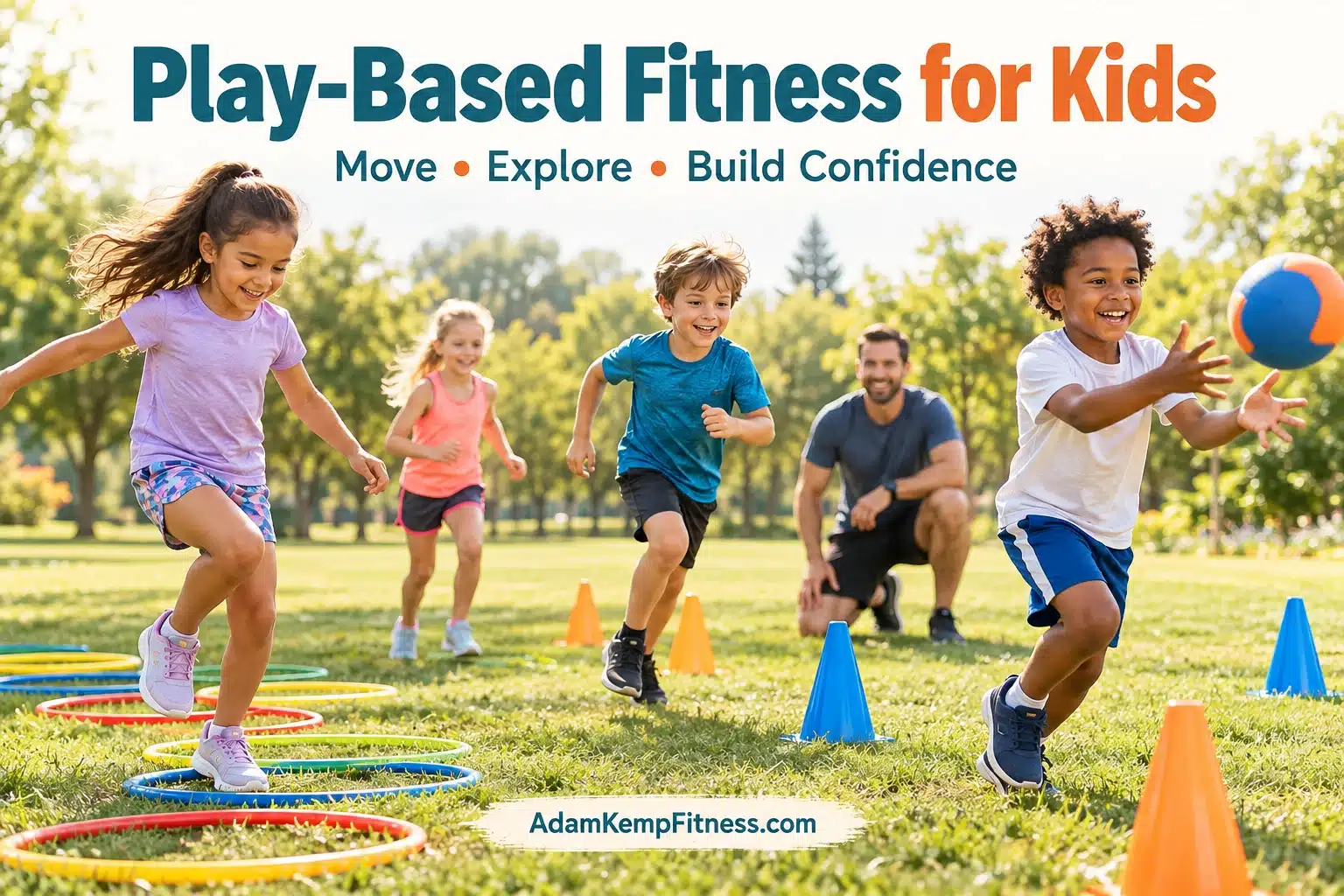
Examples include pretending to move like animals, throwing soft balls at targets, or designing a course with cones and floor markers.
The defining feature is meaningful participation: children have something interesting to do rather than simply repeat tasks.
Play and structure can coexist, as practical approaches to physical education illustrate.
Adults can set boundaries, demonstrate a skill, and then let children choose how to practice it.
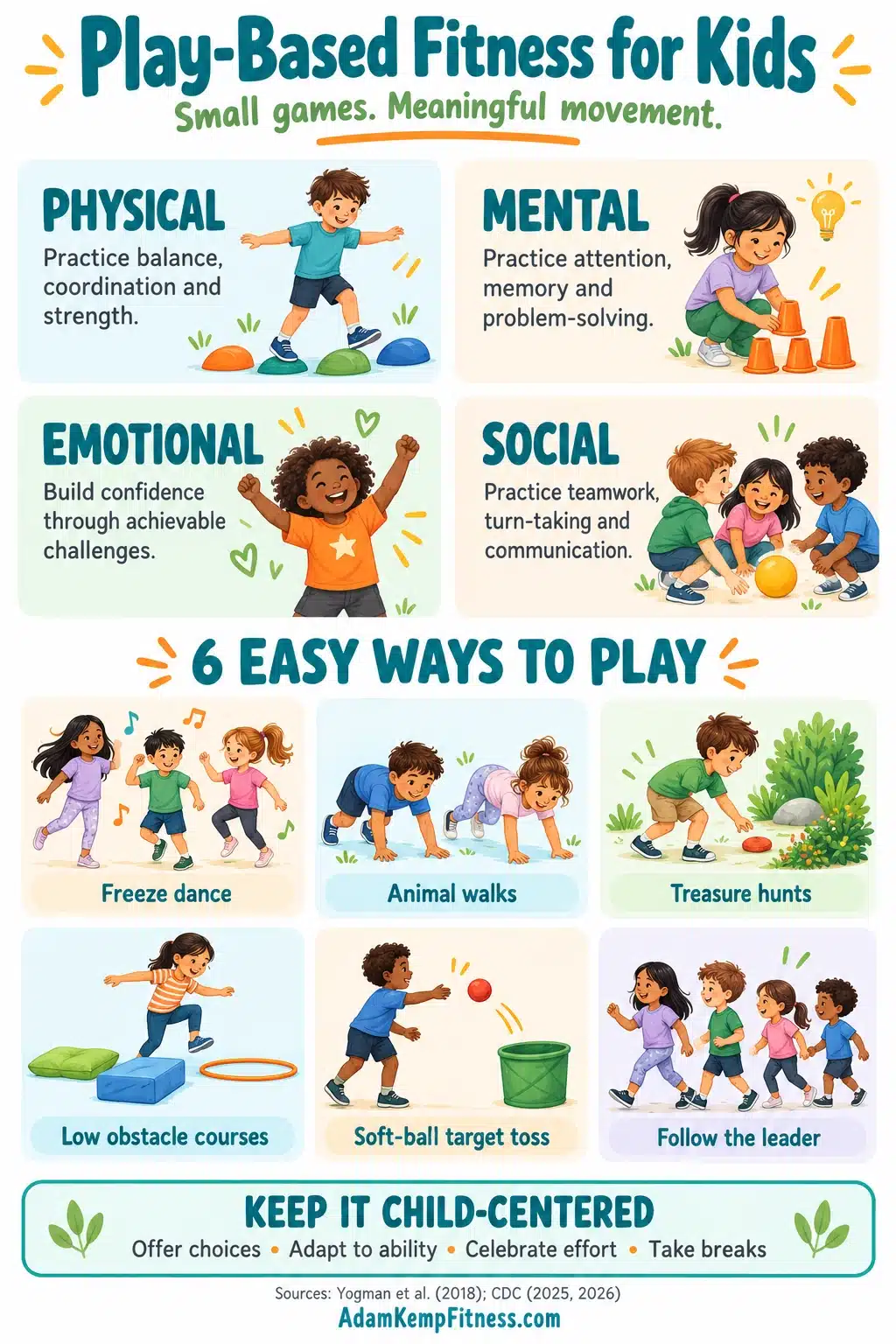
Physical Benefits of Play-Based Fitness
Play-based fitness for kids creates opportunities to practice strength, balance, coordination, and endurance through enjoyable activities like climbing, chasing, and jumping.
These movements can contribute to the aerobic, muscle-strengthening, and bone-strengthening activity children need for healthy development (Centers for Disease Control and Prevention, 2025).
Strength, Endurance, and Bone Health
Active games can provide several types of exercise in the same session.
Running games provide aerobic activity, climbing challenges muscles, and jumping provides bone-strengthening activity (CDC, 2025).
However, calling an activity “play” does not automatically make it sufficiently active.
Look at how much children actually move, especially in games where long lines or elimination rules leave most participants standing around.
Try small groups, multiple stations, or several balls so everyone has opportunities to participate. For more possibilities beyond organized sessions, explore these benefits of outdoor games and outside play activities.
Balance, Coordination, and Athletic Skills
A simple obstacle course can ask children to step over a low obstacle, walk along a floor line, and toss a beanbag into a basket.
Each task provides a different opportunity to practice body control.
There is also direct research supporting game-based exercise: a randomized controlled study found that a 12-week afterschool program improved several measures of physical fitness in children aged 9–10 (Onarici Gungor et al., 2025).
That finding supports planned, game-based activity, but it does not establish that every playground game produces identical benefits.
Improvements depend on the activity, practice opportunities, instruction, and the child’s starting abilities.
Mental Benefits: Attention and Problem-Solving
Play can provide opportunities to practice executive functions, including working memory, flexible thinking, and self-control (Yogman et al., 2018).
In active games, children can practice these skills while responding to rules and changing situations.
For example, freeze dance asks children to respond to a stop signal, while a color-coded obstacle course asks them to remember a movement sequence.
Letting children redesign the course adds a practical problem-solving challenge.
Regular physical activity also supports cognitive health, although better grades are not guaranteed by any individual game or program (CDC, 2024).
My guide to the effects of sports on academic performance explores that wider relationship.
Emotional Benefits: Confidence and Managing Frustration
Play-based fitness for kids offers opportunities to experience success, work through setbacks, and practice managing emotions in a supportive environment.
When challenges match a child’s abilities and adults respond patiently, play can build confidence and support emotional regulation (Yogman et al., 2018).
Make Progress Visible
Developmentally appropriate play can support children’s sense of agency and social-emotional development (Yogman et al., 2018).
A useful coaching approach is to give children challenges they can influence through practice and choices.
For a hesitant child, start with a wide balance path before making it narrower.
Recognize a specific improvement, such as staying balanced for another step, rather than comparing the child with the fastest participant.
I would also avoid making every activity a test.
Ask, “What would you like to try next?” and let success include experimenting, asking for help, or choosing a suitable challenge.
Allow Breaks and Supportive Restarts
Play with caring adults can support emotional regulation and nurturing relationships (Yogman et al., 2018).
Keep that supportive relationship central when children become frustrated.
If an obstacle feels overwhelming, lower it, demonstrate another route, or offer a break.
Persistence should never mean requiring children to ignore pain, fear, or exhaustion.
Social Benefits: Cooperation and Belonging
Shared play gives children opportunities to negotiate rules, take turns, and practice resolving disagreements (Yogman et al., 2018).
Adults can guide these interactions while leaving children room to contribute.
For example, challenge a group to deliver beanbags to a shared “treasure chest,” with every child choosing a movement route.
Count the group’s total instead of ranking individuals.
Build inclusion into the game itself by adjusting distances, equipment, pace, and movement options.
A child might roll a ball instead of throwing it or complete an accessible route alongside a teammate.
Team-based fitness for kids immediately creates opportunities to practice cooperation, communication, and turn-taking.
Working toward a shared goal gives children a chance to encourage teammates, navigate disagreements, and recognize that everyone can contribute.
With supportive adult guidance, these playful interactions can support social and emotional development (Yogman et al., 2018).
Easy Play-Based Fitness Activities for Kids
Choose activities around your child’s interests, available space, and current abilities. These are adaptable starting points, rather than fixed developmental tests.
| Activity | Movement opportunities | Simple adaptation |
|---|---|---|
| Animal adventures | Crawling, stepping, reaching | Let children choose comfortable movements |
| Freeze dance | Moving and stopping on cue | Use seated or standing dance options |
| Treasure hunt | Walking, reaching, carrying | Place clues along accessible routes |
| Floor obstacle course | Balancing, stepping, changing direction | Keep obstacles low and stable |
| Partner target toss | Throwing, catching, rolling | Use larger targets or softer balls |
| Follow the leader | Copying varied movements | Rotate leaders and welcome different abilities |
You can find additional simple ideas to get kids moving and adapt them to your family or classroom.
Start with one game and invite children to suggest a variation.
For a short home session, try three minutes of follow the leader, five minutes of obstacle exploration, five minutes of target games, and two minutes of a child’s favorite movement.
Treat this 15-minute example as one opportunity for activity, with flexible breaks and timing.
How Much Active Play Do Children Need?
Preschool-aged children, ages 3–5, should be active throughout the day.
Children and adolescents ages 6–17 should accumulate at least 60 minutes of moderate-to-vigorous physical activity daily (CDC, 2025).
For ages 6–17, most activity should be aerobic, with vigorous activity, muscle-strengthening activity, and bone-strengthening activity included at least three days per week (CDC, 2025).
Active play can contribute to these recommendations alongside walking, school activities, and sports.
A short game is a useful contribution, but one brief session should not be presented as the entire daily requirement.
What About Fitness Classes for Kids?
Well-designed fitness classes for kids can combine clear instruction with exploration.
When observing a class, notice whether children spend their time moving, receive supportive feedback, and have options suited to different abilities.
One example is ninja training for kids, which incorporates obstacle activities and skills drawn from gymnastics, parkour, and martial arts.
Assess the actual instruction and supervision, not just the program’s name.
Ask instructors how they adapt challenges, handle hesitant participants, and manage safety.
Look for stable equipment, appropriate progressions, water breaks, and a willingness to stop an activity when a child is uncomfortable.
How Play-Based Fitness for Children Supports Long-Term Athletic Development
Play-based fitness for kids can provide variety alongside organized sport.
The American Academy of Pediatrics cautions that early specialization and intensive training can contribute to overuse injuries and burnout and encourages broader sports participation for most young athletes (Brenner, 2016).
As a basketball player, I appreciate the chance to practice different movements: changing direction, controlling a landing, tracking a ball, and responding to other people.
Play offers opportunities to explore those actions without making every session about winning.
Keep expectations realistic, however: childhood play does not guarantee elite performance or lifelong exercise habits.
My recommendation is to judge success partly by whether a child feels included, is willing to try, and wants to participate again.
Start with an enjoyable game, make room for your child’s ideas, and build from there.
Final Thoughts: How to Incorporate Play-Based Fitness into Your Child’s Life

Incorporating play-based fitness for kids can start with a game of tag, a living-room dance party, or a simple backyard obstacle course.
Choose something your child enjoys, offer a few options, and let their imagination shape the activity.
As a father and professional basketball player, I believe the priority should be helping children feel comfortable exploring movement.
Celebrate their effort, adapt challenges to their abilities, and make participation more important than winning.
Joining in also creates opportunities for connection, with shared play supporting the caring relationships that contribute to children’s social and emotional development (Yogman et al., 2018).
Start with one enjoyable activity and build a flexible routine around your family’s schedule.
This website does not provide medical advice. This website site does contain affiliate links, and purchases may earn a commission.
Read my Medical Disclaimer, Review Disclaimer, and Publishing Policies for more details. Use of this site indicates acceptance of these terms.