
A Simple Hypertrophy Training Guide for Lasting Muscle Gains
 Reading Time: 14 minutes
 I recommend my hypertrophy training guide because it should help you stimulate muscle growth without creating so much fatigue that you cannot train consistently.
Although training to failure has its place, building muscle doesn’t require you to constantly do exhausting workouts, chase soreness, or change exercises every week.
During my professional basketball career, strength training had to improve my physical capacity without compromising my ability to practice, recover, and compete.
Although I rarely spent much time directly training for hypertrophy in my career, the same principle applies when muscle growth is the primary goal: the best hypertrophy program is one you can progressively execute and recover from for months.
In reality, effective hypertrophy training depends on a relatively small number of variables.
You need productive exercises, challenging sets, sufficient weekly volume, measurable progression, adequate nutrition, and enough recovery to adapt.
What Is Hypertrophy Training?
Muscular hypertrophy is an increase in muscle size resulting from resistance training and the recovery processes that follow it.
Mechanical tension appears to be a primary driver, particularly when a muscle produces force through a controlled and appropriately challenging range of motion (Schoenfeld et al., 2021).
Metabolic stress and muscle damage may accompany productive training, but neither soreness nor a burning sensation proves that a workout will build muscle.
More useful indicators include increasing your repetitions or resistance, improving exercise execution, and completing more high-quality work over time.
You also do not need one perfect repetition range or a complicated exercise rotation.
Research indicates that muscle growth can occur across a broad range of loads when sets are performed with sufficient effort, although moderate repetition ranges are usually the most practical (Currier et al., 2023; Schoenfeld et al., 2021).
Hypertrophy Training Guide: The Main Variables
A successful hypertrophy workout balances the following variables:
| Variable | Practical starting point |
|---|---|
| Effort | Finish most working sets with 1–3 reps in reserve |
| Volume | Begin with approximately 8–12 challenging sets per muscle each week |
| Repetitions | Mostly 6–15 reps, with some work outside that range |
| Frequency | Train each priority muscle approximately twice per week |
| Rest | About 2–3 minutes for compound exercises and 1–2 minutes for isolation work |
| Progression | Add controlled reps before increasing resistance |
| Exercise selection | Choose stable, comfortable, measurable movements |
| Recovery | Adjust volume according to sleep, nutrition, stress, and other activity |
These are starting points rather than rigid laws. Your program should evolve according to your performance and recovery instead of being forced into predetermined numbers.
The Simplest Guide to Hypertrophy Training
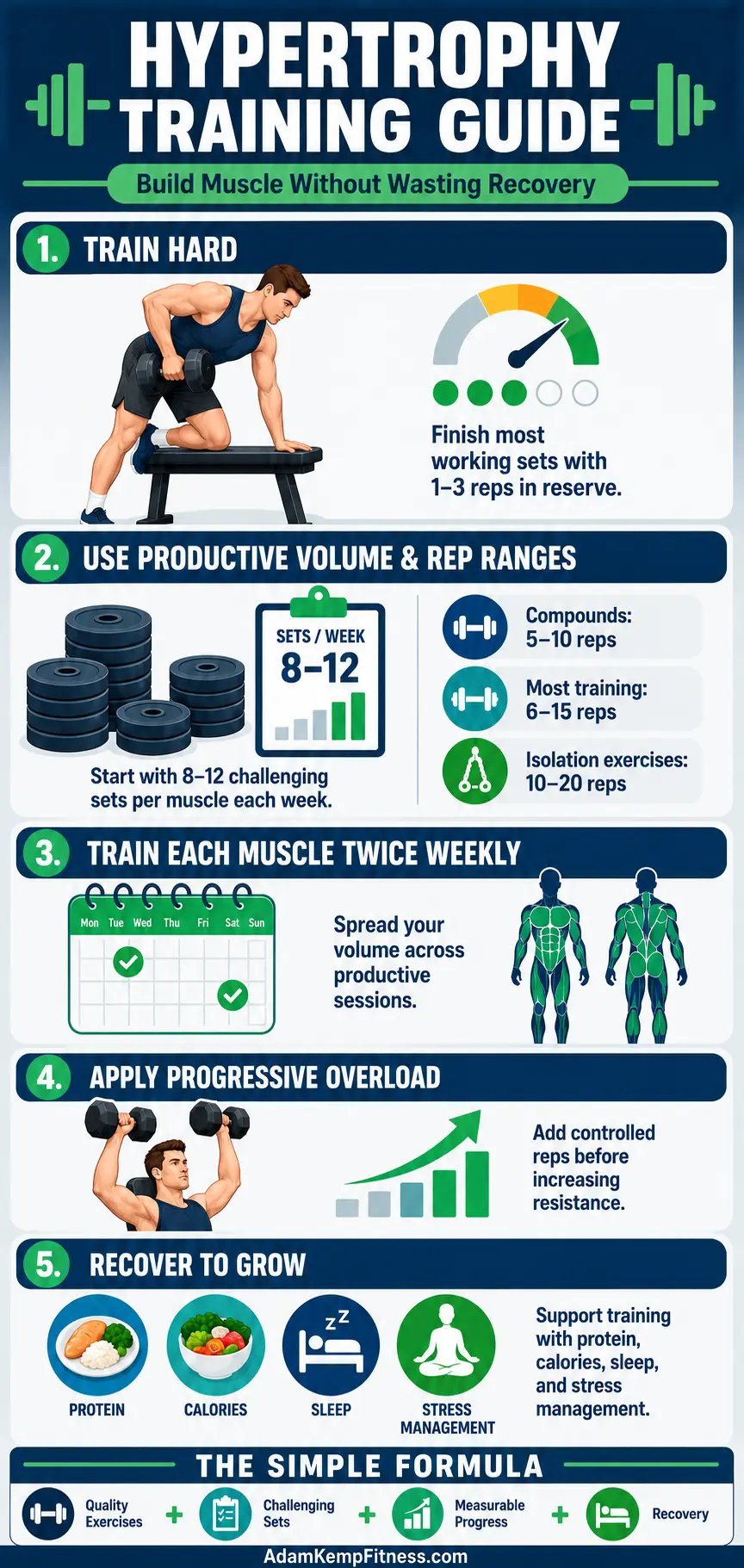
Train Close Enough to Failure
Most working sets should finish with approximately one to three repetitions in reserve, commonly abbreviated as RIR.
If you finish a set and could have completed six more repetitions, the set was probably too easy to provide a strong hypertrophy stimulus.
However, you do not need to reach absolute muscular failure on every set.
Research suggests that stopping slightly short of failure can produce similar muscle growth while reducing acute fatigue and discomfort associated with failure training (Refalo et al., 2024).
Failure can be used more freely on stable isolation exercises such as cable curls, leg extensions, lateral raises, calf raises, and machine presses.
Compound exercises such as squats, deadlifts, and free-weight presses to failure usually cause more fatigue and technical breakdown than necessary.
Your proximity to failure should also influence how you count training volume.
Ten challenging sets performed within a few repetitions of failure are not equivalent to ten casual sets stopped before the target muscles are meaningfully challenged.
How to Estimate Reps in Reserve
Estimating RIR takes practice, especially for beginners.
You can improve the skill by occasionally performing the final set of a safe exercise to technical failure and comparing the result with your initial estimate.
Technical failure occurs when you cannot complete another repetition with an acceptable range of motion and consistent technique.
You do not need to continue until the weight becomes completely immovable or your form collapses.
Accumulate Enough Weekly Training Volume
Training volume is commonly measured by the number of challenging sets completed for each muscle group per week.
In general, performing more productive sets can support greater muscle growth, but returns eventually diminish, and additional volume may become difficult to recover from (Baz-Valle et al., 2022).
Instead of automatically beginning with 20 sets per muscle, start with approximately 8–12 challenging weekly sets for the muscles you want to develop.
Beginners and returning lifters may progress with even less, while experienced lifters may eventually benefit from more.
Also, you should count direct sets first.
Three sets of leg curls provide three direct hamstring sets, while three sets of biceps curls provide three direct biceps sets.
Compound exercises also train secondary muscles, but their contribution is not always equal to direct work.
A bench press strongly trains the chest while also engaging the triceps and anterior shoulders, and a row primarily trains the back while also involving the biceps.
Evaluate your volume over at least three to six weeks.
If your performance, body measurements, and exercise technique are improving while soreness remains manageable, you probably do not need more sets.
If progress stalls, first assess your exercise effort, sleep, calorie intake, protein intake, and technique.
Add two to four weekly sets for the stalled muscle only when those foundations are already consistent.
Use a Wide but Purposeful Rep Range
Muscle can grow with both lighter and heavier loads when sets are sufficiently challenging.
However, different repetition ranges create different practical demands, so one range should not be used for every exercise.
Sets of approximately 5–10 repetitions often work well for compound exercises because they allow meaningful loading without requiring excessively long sets.
Examples include squats, presses, pull-ups, rows, and Romanian deadlifts.
Sets of approximately 10–20 repetitions are often comfortable and effective for machine and isolation exercises.
Lateral raises, curls, triceps extensions, leg extensions, calf raises, and hamstring curls usually fit well in this range.
Higher-repetition sets can be useful when heavy loading irritates a joint or equipment is limited.
The main limitation is that cardiovascular discomfort or generalized fatigue may stop the set before the target muscle becomes the limiting factor.
Very low repetitions can help increase maximal strength, but they may require more sets, heavier joint loading, and longer rest periods to accumulate enough hypertrophy-focused work.
For most lifters, keeping most training between approximately 6 and 15 repetitions offers an efficient balance.
Use Progressive Overload Without Forcing It
Progressive overload means increasing the training challenge as your body adapts. It does not mean you must add weight during every workout.
You can create progressive overload by performing more repetitions with the same resistance, adding a small amount of weight, improving your range of motion, controlling the eccentric phase more effectively, or completing the same workload with better technique.
Improvements should preserve the exercise’s intent rather than turning it into a different movement.
Use Double Progression
Double progression is one of the simplest ways to organize a hypertrophy program.
Select a repetition range, increase your repetitions within that range, and raise the weight after reaching the top of the range.
For example, program three sets of 8–12 repetitions for the dumbbell bench press:
- Begin with a weight you can control for approximately 8–10 repetitions per set.
- Keep the same weight until you can perform 12 controlled repetitions on all three sets.
- Increase the resistance by the smallest practical amount.
- Allow your repetitions to return toward the lower end of the range.
- Gradually build back toward 12 repetitions.
You do not need to improve during every session.
Sleep, stress, nutrition, and normal performance variation mean that progression is better evaluated across several weeks.
Keep a training log containing your exercises, sets, repetitions, resistance, and estimated RIR.
Without these records, it is difficult to distinguish genuine progressive overload from a workout that merely felt productive.
Choose Stable, Comfortable, and Measurable Exercises
The best hypertrophy exercises are movements that train the intended muscle, fit your structure, and allow gradual progression.
Free weights, machines, cables, and bodyweight exercises can all build muscle.
A balanced program should generally include:
- A squat or leg-press pattern
- A hip-hinge movement
- A knee-flexion exercise for the hamstrings
- Horizontal and vertical pressing
- Horizontal and vertical pulling
- Targeted shoulder and arm exercises
- Direct calf and abdominal work when appropriate
You don’t need to use a barbell variation just because it is considered traditional.
Workout machines can be excellent for building muscle because their stability allows you to focus on force production and train close to failure with less concern about balance.
Free weights remain valuable because they are versatile, measurable, and effective for developing strength.
Your program can combine both rather than treating machines and free weights as opposing training philosophies.
Exercise selection should also reflect the stimulus-to-fatigue ratio.
A movement is productive when it strongly challenges the target muscle without causing disproportionate joint discomfort, cardiovascular fatigue, setup difficulty, or recovery demands.
For example, back squats and deadlifts can be valuable, but a leg press or Romanian deadlift may sometimes let you accumulate more targeted muscle-building work with less systemic fatigue.
The correct choice depends on your goals, injury history, structure, and training environment.
If an exercise repeatedly causes sharp pain, numbness, or lingering joint irritation, do not force it because someone else considers it essential.
Adjust the grip, stance, range of motion, load, setup, or exercise variation, and have persistent symptoms evaluated by an appropriate health professional.
Train Muscles Through a Productive Range of Motion
Use the largest range of motion you can control comfortably and consistently.
This does not mean forcing every joint into its maximum possible position.
Your range should keep tension on the intended muscle without creating sharp pain or causing technique to deteriorate.
Over time, improving strength and control at longer muscle lengths may provide an additional opportunity for growth, but this should be developed progressively rather than forced.
Do not shorten the movement simply to lift more weight.
If increasing the resistance substantially reduces your range of motion, control, or connection with the target muscle, the added weight may not represent meaningful progression.
Rest Long Enough Between Sets
Rest periods should allow you to repeat high-quality efforts.
Compound exercises commonly require approximately two to three minutes, while many isolation exercises can be repeated after one to two minutes of rest (Schoenfeld et al., 2021).
Short rest periods are not automatically better for hypertrophy.
They may create a stronger burn, but they can also reduce the repetitions and resistance you can use during subsequent sets.
Use your performance as a guide.
If your repetitions collapse from one set to the next despite consistent effort, slightly longer rest may improve the quality of your training.
How Often Should You Train Each Muscle?
Training a muscle approximately twice per week is a practical starting point because it distributes weekly volume across multiple sessions.
However, frequency primarily helps organize volume and fatigue rather than independently guaranteeing more muscle growth (Schoenfeld et al., 2021).
A muscle trained with 10 weekly sets may respond well whether those sets are distributed across two or three sessions.
The better option is usually the schedule that produces higher-quality sets and fits your week.
Common hypertrophy training schedules include:
- Three-day full-body routine
- Four-day upper-lower split
- Four-day push-pull split
- Five-day upper-lower-body-part hybrid
- Six-day push-pull-legs routine
More training days are not necessarily superior. Choose the lowest frequency that lets you complete your weekly work without excessively long or unproductive sessions.
Sample Four-Day Hypertrophy Training Program
A four-day upper-lower split is flexible enough for many intermediate lifters.
It trains each major muscle group twice per week while leaving room for recovery, conditioning, sports, and family responsibilities.
Day 1: Upper Body
- Dumbbell or barbell bench press: 3 sets of 6–10
- Chest-supported row: 3 sets of 8–12
- Incline machine or dumbbell press: 2 sets of 8–12
- Lat pulldown or pull-up: 3 sets of 8–12
- Lateral raise: 3 sets of 12–20
- Cable curl: 2 sets of 10–15
- Triceps extension: 2 sets of 10–15
Day 2: Lower Body
- Squat or leg press: 3 sets of 6–10
- Romanian deadlift: 3 sets of 6–10
- Split squat or reverse lunge: 2 sets of 8–12 per leg
- Leg curl: 3 sets of 10–15
- Calf raise: 3 sets of 8–15
- Abdominal exercise: 2–3 sets
Day 3: Rest or Low-Intensity Activity
Walking, light mobility work, or easy aerobic exercise can support general health without substantially interfering with recovery.
Avoid turning every rest day into another demanding workout.
Day 4: Upper Body
- Pull-up or lat pulldown: 3 sets of 6–10
- Incline dumbbell or machine press: 3 sets of 8–12
- Cable or machine row: 3 sets of 10–15
- Machine shoulder press: 2 sets of 8–12
- Cable fly: 2 sets of 12–20
- Rear-delt raise: 2 sets of 12–20
- Biceps curl: 2 sets of 10–15
- Triceps pressdown: 2 sets of 10–15
Day 5: Lower Body
- Hack squat or leg press: 3 sets of 8–12
- Hip thrust or back extension: 3 sets of 8–12
- Leg extension: 2 sets of 12–20
- Seated or lying leg curl: 3 sets of 10–15
- Calf raise: 3 sets of 10–20
- Abdominal exercise: 2–3 sets
Begin with approximately two or three repetitions in reserve on most exercises.
Over several weeks, you can gradually work closer to failure as your technique and tolerance improve.
This program is a template rather than an individualized prescription.
Adjust exercises and weekly volume based on your experience, available equipment, recovery capacity, medical history, and specific muscle-building priorities.
Recovery Determines Whether Hypertrophy Training Works
Hypertrophy training creates the stimulus, but recovery allows your body to adapt to it.
More training is only helpful when you can recover and return with enough capacity to perform productive work.
Most adults should get at least seven hours of sleep regularly, while many people perform better with closer to eight or nine hours (Watson et al., 2015).
If work stress, travel, parenthood, sports practice, or poor sleep reduces your recovery, temporarily lowering training volume may be more effective than forcing your normal workload.
Recovery does not require eliminating all physical activity between lifting sessions.
Walking, mobility exercises, and low-intensity conditioning can support your health as long as they don’t leave you too fatigued for your next workout.
Nutrition for Muscle Hypertrophy
A modest calorie surplus generally creates the most favorable environment for gaining muscle.
However, beginners, returning lifters, and people with higher body-fat levels may sometimes gain muscle while eating around maintenance or in a small deficit.
A reasonable surplus is one that supports gradual weight gain without producing unnecessary increases in body fat.
Large calorie surpluses do not force muscle tissue to grow at an unlimited rate.
Daily protein intake of approximately 1.6 grams per kilogram of body weight appears sufficient to maximize average resistance-training adaptations for many adults.
Because individuals respond differently, an intake range of approximately 1.6–2.2 grams per kilogram (about 0.7–1 gram per pound) provides a practical target (Morton et al., 2018).
Distribute protein across three to five meals instead of relying on one extremely large serving.
Protein powder can help when whole-food meals are inconvenient, but it is not inherently more muscle-building than a well-planned diet.
Complex carbohydrates can support training performance and help you maintain productive workout volume. Dietary fat, fruits, vegetables, fluids, and adequate sodium also contribute to overall health and training readiness.
Supplements That May Support Muscle Growth
Supplements should improve an already-functional program rather than compensate for inconsistent training or nutrition.
The most useful options are generally simple and well studied.
Creatine monohydrate can improve high-intensity exercise capacity and support greater training adaptations over time.
A daily dose of approximately 3–5 grams is sufficient for most adults, and a loading phase is optional (Kreider et al., 2017).
Protein powder is useful when you struggle to meet your protein target through food.
Whey concentrate and isolate are both effective, and the better choice generally depends on digestion, budget, and nutritional preferences.
Caffeine can improve training performance for some people, but more is not always better.
Excessive or late-day caffeine may interfere with sleep, which can undermine the recovery it was supposed to support.
If you have a medical condition, take medication, are pregnant or breastfeeding, or have concerns about a supplement, consult your physician or a registered dietitian before using it.
When Should You Deload?
A deload is a planned reduction in training stress that allows accumulated fatigue to decrease.
It may involve fewer sets, lighter weights, greater distance from failure, or a combination of all three.
Signs that you may benefit from a deload include:
- Declining performance across several workouts
- Persistent muscle soreness
- Reduced motivation to train
- Worsening sleep
- Increased irritability
- Repeated joint discomfort
- Unusually high effort during normal working sets
You do not necessarily need to deload on a fixed schedule.
Some lifters benefit from a lighter week every four to eight weeks, while others can train longer before fatigue requires a planned reduction.
Do not overhaul your program after one bad workout.
Look for trends across multiple sessions and reduce training stress when performance and recovery decline together.
How to Measure Hypertrophy Progress
Scale weight alone cannot tell you whether you are gaining muscle.
Use several measurements to evaluate progress more accurately.
Track:
- Exercise loads and repetitions
- Circumference measurements
- Progress photos under consistent conditions
- Average weekly body weight
- Exercise technique and range of motion
- Sleep, soreness, and general recovery
Review these indicators every four to six weeks rather than reacting to daily fluctuations.
Muscle growth is slow enough that constantly changing the plan can hide whether it was working.
Common Hypertrophy Training Mistakes
Changing Exercises Too Frequently
Exercise variety can be useful, but changing movements every week makes progression difficult to measure. Keep your foundational exercises consistent long enough to improve your technique and performance.
Adding Volume Before Improving Effort
More sets will not necessarily solve a program built around easy, unfocused training. Learn to perform your existing sets with consistent technique and appropriate effort before adding more work.
Taking Every Set to Failure
Failure training can be useful, but applying it indiscriminately creates unnecessary fatigue. Reserve it primarily for controlled exercises or selected final sets.
Confusing Soreness With Progress
Soreness is influenced by novelty, muscle length, volume, and exercise selection. You can build muscle without becoming severely sore after every workout.
Ignoring Recovery
A technically perfect program can fail when sleep, nutrition, or stress management is consistently poor. Training volume must fit the life you are currently living.
Program Hopping
Evidence-based training still requires patience.
Most well-designed programs need several consistent weeks before you can judge their effectiveness.
Frequently Asked Questions About Training for Hypertrophy
Final Thoughts: Building a Sustainable Hypertrophy Program
The most effective hypertrophy training guide is not the one with the most exercises, sets, or advanced methods. It is the one that helps you perform challenging, measurable work while managing fatigue well enough to progress.
Choose movements you can control, complete most sets close to failure, begin with a recoverable amount of volume, and add repetitions or resistance gradually.
Support that work with adequate protein, calories, sleep, and patience.
Muscle gain comes from thousands of productive repetitions, not one perfect workout. The lifter who continues executing a sensible plan will usually outperform the person constantly searching for a more dramatic one.
This website does not provide medical advice. This website site does contain affiliate links, and purchases may earn a commission.
Read my Medical Disclaimer, Review Disclaimer, and Publishing Policies for more details. Use of this site indicates acceptance of these terms.