10 Best Foods That Suppress Appetite & How to Consume Them
 Reading Time: 13 minutes
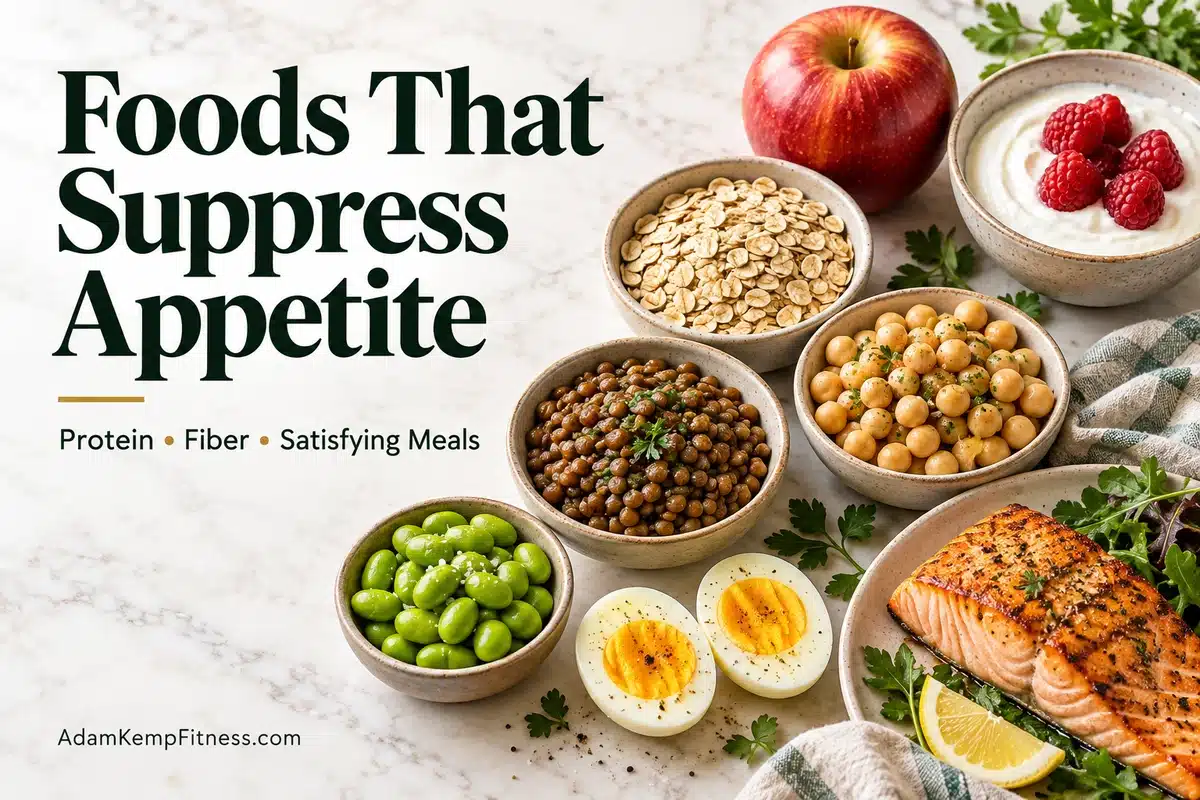
 Consuming foods that suppress appetite can help make meals more satisfying, especially when they provide protein, fiber, or plenty of water.
Research supports these characteristics as useful tools for managing hunger, although feeling fuller does not always translate into eating fewer calories (Kohanmoo et al., 2020; Clark & Slavin, 2013; Rolls, 2009).
Including these foods can be particularly useful if you struggle with hunger between meals or want to make a weight-management plan feel more manageable.
The goal is to build meals that leave you comfortably satisfied while providing the nutrients your body needs.
The benefits of consuming these appetite suppressing foods also extend beyond appetite control, as protein supports the maintenance and repair of body tissues, while fiber supports digestive health and bowel regularity (National Institute of Diabetes and Digestive and Kidney Diseases, n.d.).
Combining these foods gives you more ways to meet those needs throughout the day.
Greek yogurt with raspberries, oatmeal with yogurt and chopped apples, or salmon with a lentil salad brings protein and fiber-containing ingredients together in meals that offer more nutritional variety than either food alone.
I recommend using these combinations as flexible starting points, adjusting portions to your hunger, activity level, and goals.
The most useful appetite-suppressing foods are the ones that help you feel well fed while making a balanced eating pattern easier to maintain!
How Do Foods That Suppress Appetite Work?
“Appetite suppression” commonly describes reduced hunger or desire to eat, but two more specific terms help explain what happens around meals.
Satiation helps bring a meal to an end, while satiety describes the reduced hunger that follows eating (Li et al., 2014).
For everyday meal planning, the goal is to feel satisfied during a meal and stay reasonably comfortable until the next eating occasion.
Protein, certain fibers, food volume, and physical structure can contribute, but no single characteristic guarantees a particular response.
Protein and Satiety
Protein has relatively consistent evidence for improving short-term fullness. A
meta-analysis covering 49 acute publications found that higher-protein intake reduced hunger and increased fullness compared with calorie-matched lower-protein conditions (Kohanmoo et al., 2020).
Protein also affected several appetite-related hormones, including lower ghrelin and higher cholecystokinin and GLP-1.
However, longer-term findings were inconclusive, so a more satisfying protein-rich meal should not be presented as a guarantee of lasting appetite suppression or weight loss (Kohanmoo et al., 2020).
Fiber and Satiety
Fiber can contribute to filling meals, but the claim that all fiber automatically keeps you full is too broad.
In one systematic review, only 39% of the tested fiber interventions significantly improved subjective appetite ratings, and 22% reduced food or energy intake (Clark & Slavin, 2013).
Certain fibers, including oat beta-glucan, showed more consistent support across studies.
Certain fibers also act as prebiotics, feeding beneficial gut microbes, and regularly consuming them can influence the microbiome’s composition and activity over time (Gibson et al., 2017; So et al., 2018).
Microbial fermentation produces short-chain fatty acids that can influence appetite-related signals, offering a potential pathway for longer-term effects on fullness (Chambers et al., 2015).
Food Volume and Physical Structure
Energy density describes how many calories a food contains per gram.
Foods with more incorporated water can provide a larger portion for a given calorie amount, which can help support fullness and reduce meal energy intake (Rolls, 2009).
Physical structure matters, too, as, for example, whole apples produced greater satiety than applesauce or juice in a controlled trial.
Even adding fiber back into the juice did not reproduce the whole apple’s satiety effect (Flood-Obbagy & Rolls, 2009).
Does Nutrient Density Help With Satiety?
Nutrient density describes a food’s contribution of beneficial nutrients relative to its energy content.
Nutrient-dense choices provide vitamins, minerals, and other useful dietary components without relying heavily on added sugars or other calorie sources that contribute few essential nutrients (U.S. Department of Agriculture & U.S. Department of Health and Human Services, 2020).
However, nutrient density and fullness are not interchangeable.
For explaining satiety, the evidence discussed here is more directly about protein, fiber characteristics, energy density, and food structure than about vitamin or mineral content alone.
A nutrient-dense food can also contain substantial calories, and a very low-calorie food may provide too little energy or protein to serve as a satisfying meal.
I recommend considering both questions: “Does this meal nourish me?” and “Does this amount of food comfortably satisfy me?”
10 Foods That Suppress Appetite Naturally
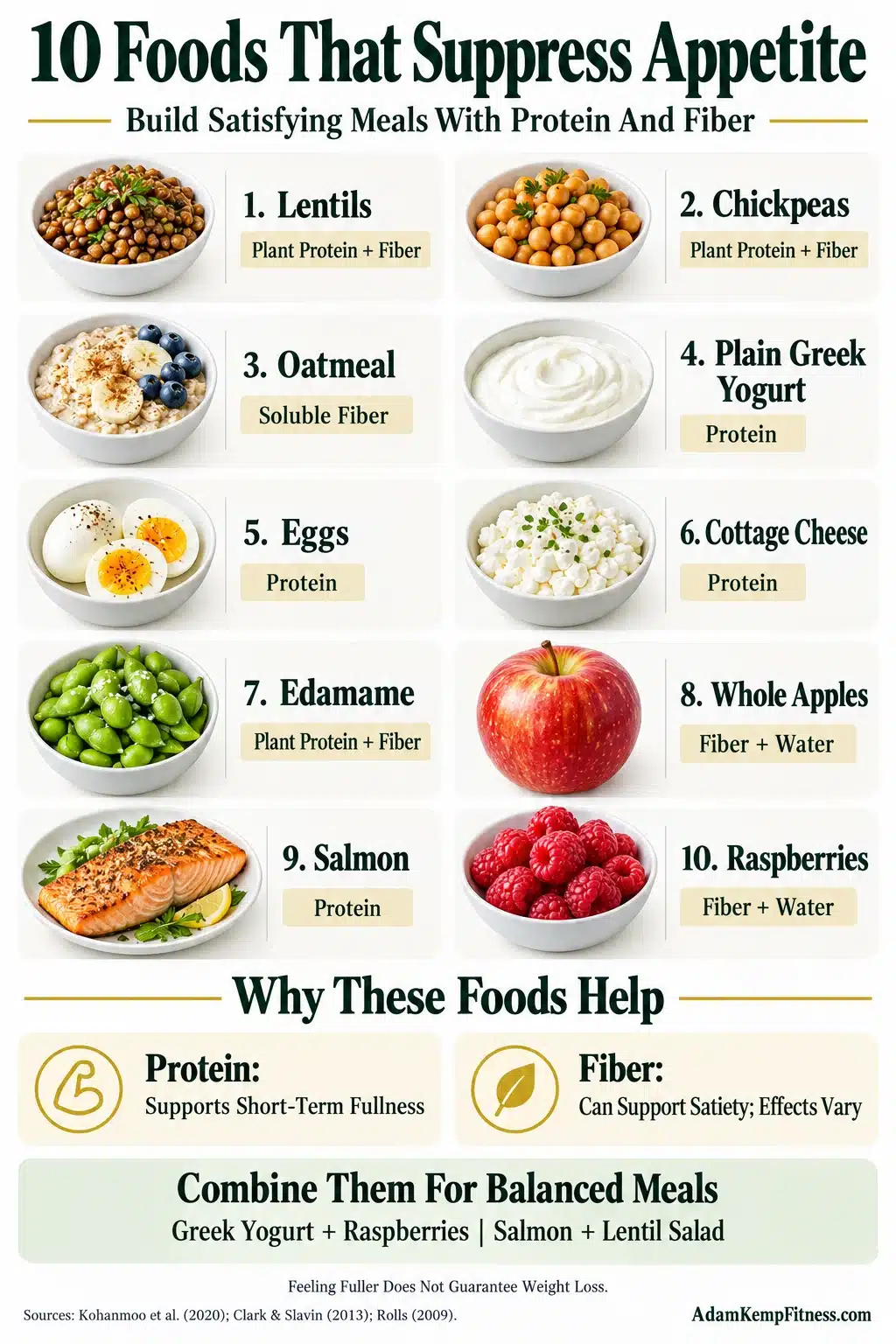
These foods that suppress appetite naturally offer different ways to build satisfying meals and snacks.
The order is not a ranking of their appetite-suppressing strength, and individual preferences, portions, and meal combinations will affect how useful each one feels.
1.) Lentils
Lentils belong to the pulse family alongside beans, chickpeas, and dried peas, and combine plant protein and fiber, making them a practical foundation for meals focused on fullness.
A meta-analysis of nine acute feeding trials found that pulses increased satiety compared with calorie-matched control foods, although they did not significantly reduce intake at the next meal (Li et al., 2014).
Try lentils in a vegetable soup, tomato-based stew, or salad with cucumbers and herbs.
I would use them as a substantial meal ingredient rather than a small garnish.
2.) Chickpeas
Chickpeas provide another combination of plant protein and fiber, with the convenience of being available canned or dried.
For an easy meal, combine chickpeas with chopped tomatoes, cucumber, red onion, and a lemon dressing.
You can also roast them for a snack or add them to soups and grain bowls.
Hummus is another option, but consider the full snack: a few spoonfuls with vegetables serves a different role from a large bowl with generous amounts of oil and crackers.
Hippeas Chickpea Puffs are one of my favorite on-the-go snacks. Although they are still a processed food and don’t contain as many nutrients as regular chickpeas, they work as a satisfying snack.
Choose the portion and accompaniments that fit the meal you need.
3.) Oatmeal
Oatmeal is one of my all-time favorite foods for improving my body composition and it is especially useful because researchers have studied the prepared food directly.
In a randomized crossover trial, an oatmeal breakfast increased fullness and reduced subsequent lunch intake compared with an equal-calorie oat-based ready-to-eat cereal breakfast (Rebello et al., 2016).
The researchers identified differences in viscosity and beta-glucan characteristics that may help explain the results.
For a practical breakfast, try oats with plain Greek yogurt and fruit.
Adjust the portion and toppings to your needs instead of assuming that a small bowl of oats must keep everyone satisfied for hours.
4.) Plain Greek Yogurt
Plain Greek yogurt is a convenient protein-rich base for breakfast or a snack, and a small randomized trial even found that a higher-protein yogurt snack improved several appetite-control measures compared with energy-dense crackers or chocolate snacks (Ortinau et al., 2014).
However, another study found no additional appetite-control benefit when higher-protein Greek-style yogurt was compared with regular yogurt.
The comparison food matters, and a higher protein number does not always produce a noticeable difference in fullness (Ortinau et al., 2013).
I recommend pairing plain Greek yogurt with apples, raspberries, or oats.
This provides a simple way to build a snack around both a protein food and a fiber-containing ingredient.
5.) Eggs
Eggs are one of the most nutrient-dense foods in the world and a versatile option for building a more substantial breakfast.
In a crossover study involving women with overweight or obesity, an egg-based breakfast produced greater satiety and lower lunch intake than a calorie- and weight-matched bagel breakfast (Vander Wal et al., 2005).
Try eggs with vegetables and whole-grain toast, or serve them alongside fruit and oatmeal.
6.) Cottage Cheese
Cottage cheese offers a convenient alternative when you want a protein-containing food without cooking.
A small trial found similar satiety responses after cottage cheese and omelette snacks despite differences in post-meal nutrient and hormone responses (Marsset-Baglieri et al., 2015).
For a sweet option, add raspberries and cinnamon.
For a savory version, try cucumber, tomatoes, black pepper, and whole-grain toast.
7.) Edamame
Edamame are young soybeans that contribute both plant protein and fiber, which makes them a useful option for readers who want a plant-based snack or an additional protein ingredient for meals (U.S. Department of Agriculture, n.d.-a; NIDDK, n.d.).
Try steamed edamame with lemon and a little salt, or add shelled edamame to a rice bowl with vegetables.
They can also be mixed into salads when you want something more substantial than vegetables alone.
8.) Whole Apples
Whole apples deserve a place among foods that suppress appetite because they have direct research comparing different forms of the same fruit.
In a study of 58 adults, eating apple slices before lunch produced greater satiety than applesauce or apple juice (Flood-Obbagy & Rolls, 2009).
The whole-apple condition also reduced total lunch energy intake, including the apple, compared with the no-preload condition.
Enjoy an apple on its own when that matches your hunger, or pair it with Greek yogurt or peanut butter for a more substantial snack.
Keeping the skin on is another way to retain a fiber-containing part of the fruit.
9.) Salmon
Salmon provides protein alongside nutrients such as long-chain omega-3 fats and vitamin D.
Those additional nutrients make it a useful example of nutritional value extending beyond a food’s potential effects on fullness (U.S. Department of Agriculture, n.d.-a; Office of Dietary Supplements, n.d.-a, n.d.-b).
I serve salmon with vegetables like broccoli or asparagus and a satisfying carbohydrate source, such as potatoes, rice, or lentils.
You can use fresh, frozen, or canned salmon, depending on your budget and preferred recipes.
10.) Raspberries
Raspberries are a useful choice for increasing the fiber content of a meal or snack, as one cup provides approximately 8 grams of fiber, according to USDA nutrition information (U.S. Department of Agriculture, n.d.-b).
Add fresh or unsweetened frozen raspberries to oatmeal, yogurt, or cottage cheese.
How to Build More Satisfying Meals
My recommendation is to start with a protein-containing food, add a fiber-containing ingredient, and include enough total food to meet the needs of that eating occasion.
The examples below put those principles into practice without requiring every meal to look the same.
| Meal or Snack | Suggested Combination |
|---|---|
| Breakfast | Oatmeal with Greek yogurt and raspberries |
| Savory Breakfast | Eggs with whole-grain toast and tomatoes |
| Lunch | Lentil and vegetable soup with bread |
| Afternoon Snack | A whole apple with cottage cheese |
| Plant-Based Meal | Chickpeas and edamame with rice and vegetables |
| Dinner | Salmon with potatoes and a vegetable side |
If you are increasing fiber, make changes gradually and drink enough fluids to help it work properly.
I recommend adding fiber a little at a time so your body can adjust, but work on taking in more fiber each day.
Treat these combinations as starting points rather than fixed prescriptions.
If a meal repeatedly leaves you hungry soon afterward, reassess its size and composition rather than assuming you need a stronger appetite-suppressing ingredient.
Frequently Asked Questions About Appetite Suppressing Foods
Final Thoughts: Foods That Suppress Your Appetite
I recommend choosing foods that suppress appetite by making meals more nourishing and satisfying, with an emphasis on protein, fiber, and enjoyable combinations.
Start with a few options you already like rather than trying to overhaul your entire diet at once.
A bowl of oatmeal with yogurt and raspberries, a lentil-based lunch, or salmon with vegetables can all be useful starting points.
Judge the result by whether you feel comfortably fed and can maintain the routine, not by how long you can avoid eating.
This website does not provide medical advice. This website site does contain affiliate links, and purchases may earn a commission.
Read my Medical Disclaimer, Review Disclaimer, and Publishing Policies for more details. Use of this site indicates acceptance of these terms.
Check Out Some of My YouTube Videos Below, and Please Follow on YouTube for More Educational Health and Fitness Content!