How to Get CPR Certified Online for Fitness Enthusiasts
 Reading Time: 8 minutes
Learning how to get CPR certified online for fitness enthusiasts starts with choosing a course that fits your goals, checking any workplace requirements, and completing the coursework and required skills assessment.
Online learning offers flexibility, but American Heart Association CPR courses also require hands-on skills verification before you receive a course completion card (American Heart Association [AHA], n.d.).
As a professional basketball player and certified personal trainer, I view emergency preparedness as a valuable part of being involved in fitness.
We put considerable effort into improving our own performance, and learning CPR adds a practical way to support the people we train alongside.
Before choosing a provider offering how to get cpr certified online, check whether its training includes CPR, automated external defibrillator (AED) use, and the practical assessment your employer or certifying organization requires.
Understanding those differences is an essential first step in researching how to get CPR certified online as a fitness enthusiast.
Whether you lift recreationally, coach a youth team, or work with personal training clients, CPR education deserves a place alongside your other fitness skills.
Choosing training that develops practical ability and meets your needs is the foundation of understanding how to get CPR certified online for fitness enthusiasts.
Why CPR and AED Training Matter in Fitness Settings
CPR training is relevant to fitness because exercise facilities bring people together during physical activity, where a bystander may be the first person to recognize an emergency.
A 2024 study examined 9,290 adult cardiac arrests at recreational facilities, and bystanders performed CPR in 61.3% of cases (Kolkailah et al., 2024).
The same study found that the median state-level rate of bystander AED application was approximately 19% in states requiring AEDs at athletic facilities.
However, the registry also included locations such as parks and beaches, and researchers could not confirm whether an AED was available at each incident.
The practical lesson is that equipment, training, and an accessible emergency plan need to work together.
For a workout partner or trainer, preparedness includes knowing where the AED is and how to direct someone to retrieve it.
Can You Get CPR Certified Entirely Online?
You can study CPR online, but online-only coursework and a credential that includes demonstrated CPR skills are different things.
The American Red Cross specifically states that its online-only CPR classes do not qualify for workplace certification needs without an in-person skills session (American Red Cross, n.d.).
The AHA offers several pathways, including blended learning and self-guided learning with an approved skills verification station.
These options combine online education with hands-on practice and assessment, rather than relying solely on a written quiz (AHA, n.d.).
Before paying, confirm exactly what you will receive and who must accept it.
A downloadable certificate does not, by itself, establish that a course meets your gym’s or professional organization’s requirements.
How to Get CPR Certified Online: Step by Step
The most useful approach is to work backward from your intended use.
Establish what training you need before comparing course prices or scheduling study sessions.
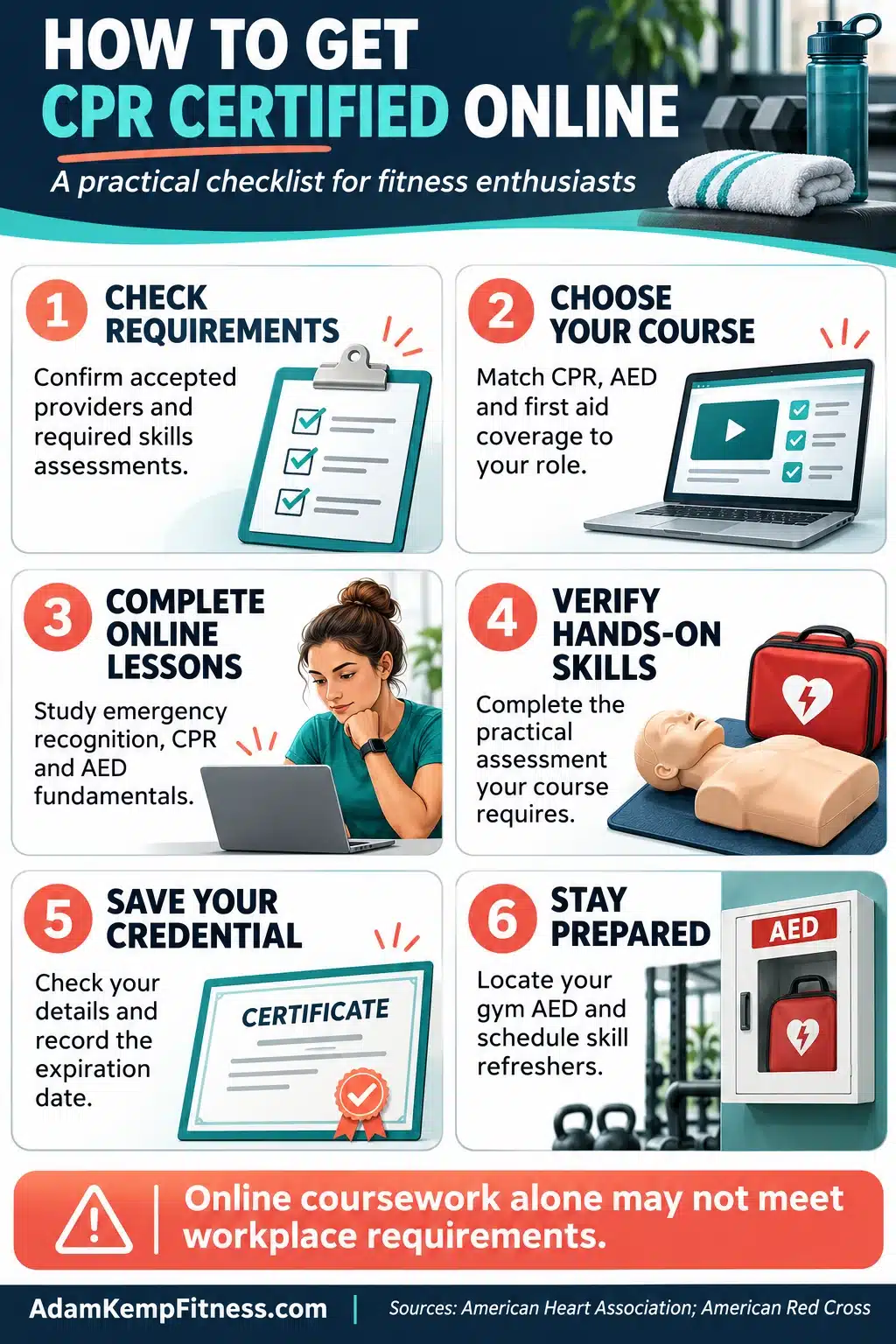
1.) Identify Your Certification Requirements
Start by deciding whether you want CPR education for personal preparedness, employment, coaching, or a professional fitness credential.
If another organization must accept your training, request its requirements before enrolling.
Ask your employer or certifying organization:
- Which training providers and course titles do you accept?
- Is adult CPR/AED sufficient, or are first aid and pediatric CPR required?
- What type of hands-on assessment must I complete?
- Do you require Basic Life Support, or a community CPR/AED course?
- What documentation must I submit?
For anyone learning how to become a successful personal trainer, this is part of professional preparation.
Keep the organization’s answer so you can compare its requirements with the course description.
2.) Choose CPR Training That Fits Your Fitness Environment
Consider the people you train with and the setting where you spend time.
An adult weight room, a youth basketball program, and a swimming facility present different training needs.
| Fitness setting | Course features to investigate |
|---|---|
| Adult gym or recreational sports | Adult CPR, AED use, and practical skills assessment |
| Personal training or group instruction | Employer-approved CPR/AED training and any required first aid |
| Youth coaching | Child CPR/AED, with infant training if relevant |
| Aquatic instruction | Required aquatic rescue training alongside CPR and AED skills |
| A role requiring BLS | The specific BLS course accepted by the organization |
Use this table to guide your questions rather than treating it as a universal credential checklist.
Confirm the exact course with the organization responsible for approving it.
3.) Compare Online Courses Beyond the Advertised Price
People researching how to get cpr certified online can explore self-paced courses covering cardiac arrest recognition, chest compressions, AED use, and other emergency response fundamentals.
When comparing providers, look beyond the words “online certification.”
Check the course content, assessment format, instructor support, renewal requirements, and acceptance before purchasing.
Confirm whether the advertised fee includes:
- Online learning materials and assessments.
- Hands-on practice and skills verification.
- Any required training equipment.
- The final certificate or course completion card.
- Retesting or rescheduling, if needed.
Some online courses charge separately for a practical session.
For example, the Red Cross’s Adult CPR/AED Online course identifies an additional instructor-led skills session and fee for workplace-eligible certification (American Red Cross, n.d.).
4.) Complete the Online Coursework With a Gym Scenario in Mind
Use the flexibility of online learning to study attentively and revisit unfamiliar material.
You might complete lessons after a workout or on a rest day, but give the course the same focused attention you would give a new lifting technique.
As you study, picture a specific situation: someone collapses beside a treadmill while you are nearby.
Consider who would call emergency services, who would bring the AED, and how responders would enter the building.
This turns an abstract lesson into questions you can resolve at your actual gym.
Bring any uncertainty about recognition, compressions, rescue breaths, or AED use to the practical session.
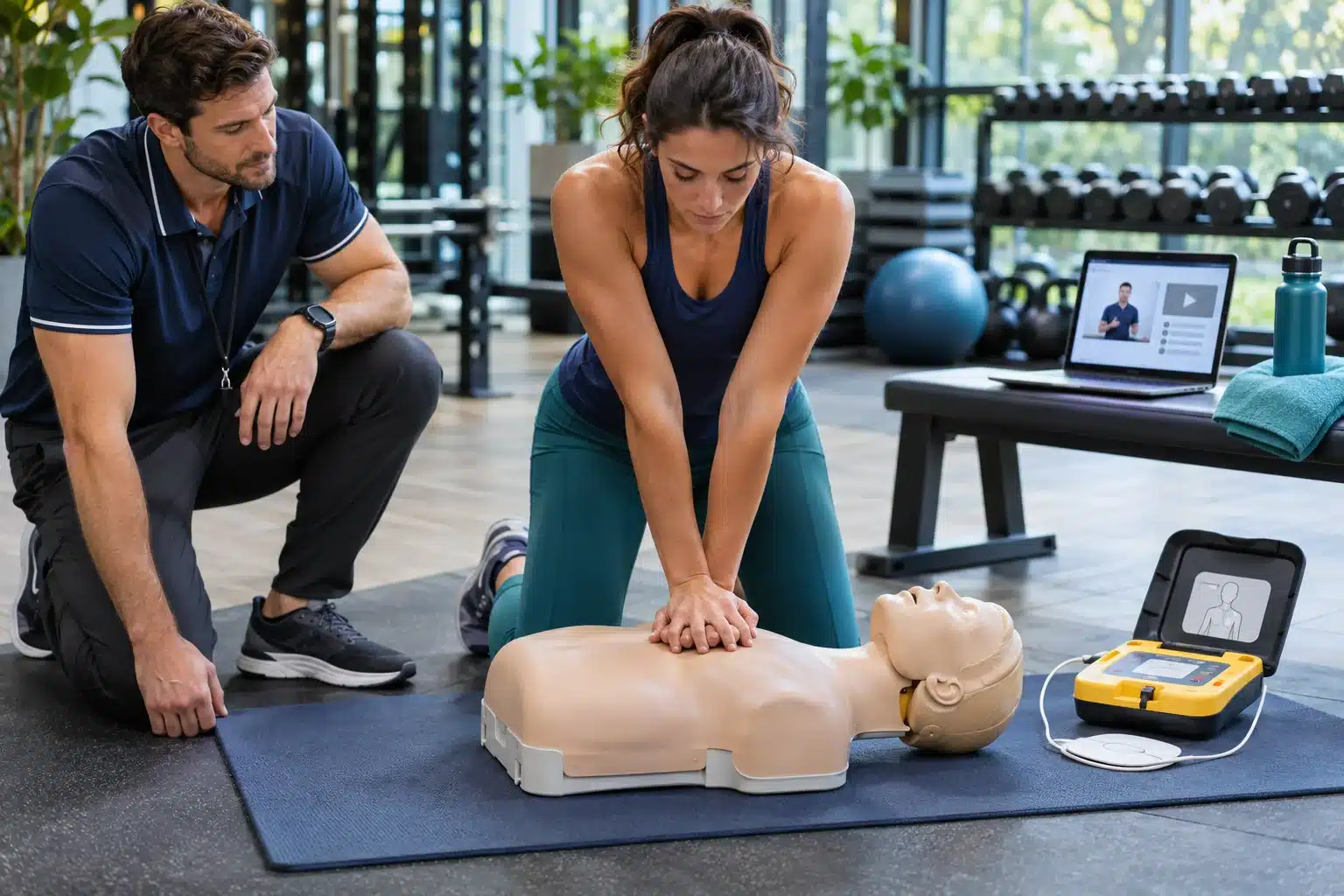
5.) Complete Hands-On Practice and Skills Verification
Watching a demonstration can explain a movement, but performing it reveals whether you can reproduce it.
CPR practice lets you apply the technique and get feedback before an emergency.
The AHA’s 2025 education guidelines recommend feedback devices during CPR training for lay rescuers.
Trials reviewed in the guidelines found improvements in measures such as compression depth and rate compliance, although evidence connecting these training improvements directly to patient survival remains limited (AHA, 2025b).
Ask whether your practical session uses a feedback-enabled manikin.
Objective feedback can help you distinguish between compressions that feel effective and compressions that meet the training targets.
Practice only on an appropriate training manikin, rather than performing chest compressions on a healthy workout partner.
6.) Save Your Credential and Schedule Refreshers
After completing every requirement, save your credential and submit it wherever needed.
Check that your name, course title, completion date, and expiration date are correct.
Red Cross CPR certification and the AHA Heartsaver course completion cards discussed here are valid for two years (American Red Cross, n.d.; AHA, n.d.).
Set a renewal reminder early enough to complete any required assessment before expiration.
Also plan brief refreshers between renewals.
The AHA’s 2025 education guidelines recommend booster sessions after a single concentrated training course to support continued practice beyond the initial class (AHA, 2025b).
What Should a Fitness-Focused CPR Course Teach?
A useful course should prepare you to recognize a possible cardiac arrest, activate emergency services, perform CPR, and use an AED.
These are central elements of adult basic life support in the AHA’s 2025 guidelines (AHA, 2025a).
For adult CPR, those guidelines specify a compression rate of 100–120 per minute and a depth of at least 2 inches, while avoiding depths greater than 2.4 inches.
Full chest recoil and minimal interruptions also matter.
Recognition deserves equal attention: an adult who is unresponsive and not breathing normally, including only gasping, needs an immediate emergency response.
Lay rescuers should not delay CPR to attempt a pulse check (AHA, 2025a).
Use these points to evaluate course coverage and reinforce your training, as a complete course provides the practice and instruction needed to apply them.
Put Your CPR Training Into Practice at Your Gym
Once you finish training, take a few minutes to understand your facility’s emergency arrangements.
A credential becomes more useful when you can connect your skills to the building, equipment, and people around you.
Ask staff to show you:
- The AED’s location and how it is accessed.
- The facility’s exact address and emergency entrance.
- How to alert staff during an incident.
- Where first aid supplies are stored.
- Who checks emergency equipment and coordinates practice drills.
Consider proposing a short emergency walkthrough with your training group.
Assign someone to simulate calling emergency services, someone to retrieve the AED trainer, and someone to meet responders at the entrance.
For me, this fits the preparation mindset of team sports: establish responsibilities before a situation demands a quick response because a gym doesn’t need to look like a professional arena to benefit from a clear plan.
Frequently Asked Questions About Online CPR Certification
Final Thoughts: How to Make CPR Preparedness Part of Your Fitness Routine
Getting CPR certified online begins with selecting an accepted course and finishes with completing its required assessments.
Follow that training by learning your gym’s emergency plan, locating the AED, and keeping your skills up to date.
As an athlete and trainer, I value preparation that serves the people around me as well as my own performance.
Learning how to get CPR certified online for fitness enthusiasts is a practical step toward bringing that approach into your training environment.
This website does not provide medical advice. This website site does contain affiliate links, and purchases may earn a commission.
Read my Medical Disclaimer, Review Disclaimer, and Publishing Policies for more details. Use of this site indicates acceptance of these terms.
Check Out Some of My YouTube Videos Below, and Please Follow on YouTube for More Educational Health and Fitness Content!