Physical Therapy for Work Injuries: A Safe Return to Work
 Reading Time: 9 minutes
Physical therapy for work injuries helps restore movement, rebuild strength, and prepare your body for your job’s demands.
When an injury happens at work rather than in the gym, recovery can also involve lost income, an employer waiting for a return date, and concerns about whether the same task will hurt you again.
If you train regularly, you know how frustrating it can be when pain changes how you reach, lift, or bend.
Returning to work adds another challenge because you need to tolerate specific tasks repeatedly, sometimes for an entire shift.
Physical therapy, also called physiotherapy, can combine exercise, symptom management, and practical guidance as you recover (National Health Service [NHS], 2025).
Whether you work in a warehouse, hospital ward, building site, or at a desk, matching rehabilitation to your daily responsibilities is central to physical therapy for work injuries.
Why Workplace Injuries Deserve a Different Recovery Plan
Work-related musculoskeletal problems can affect the back, joints, and limbs, and work may either cause or aggravate them (Health and Safety Executive [HSE], 2025).
What makes a work injury different from a weekend sprain is the finish line.
Recovery means being able to perform a specific set of physical tasks repeatedly for a full shift.
A plan that ignores those demands can leave you comfortable on the couch but unprepared for Monday morning.
Your rehabilitation goals should therefore reflect both the injury and the work you need to perform.
How Does Physical Therapy for Work Injuries Help?
Physical therapy for work injuries assesses how an injury affects movement and uses an individualized treatment plan to address pain, mobility, and strength.
Exercise, advice, and selected hands-on treatments may all play a role (NHS, 2025).
For someone returning to work, those improvements need to translate into practical abilities, such as lifting a box, reaching overhead, or tolerating time at a keyboard.
A useful rehabilitation plan connects each exercise to a measurable goal.
Rest may ease symptoms, but the next question is whether you can handle the demands that caused difficulty in the first place.
Physical therapy provides a structured way to assess and rebuild that capacity.
What Happens During Physical Therapy for a Work-Related Injury?
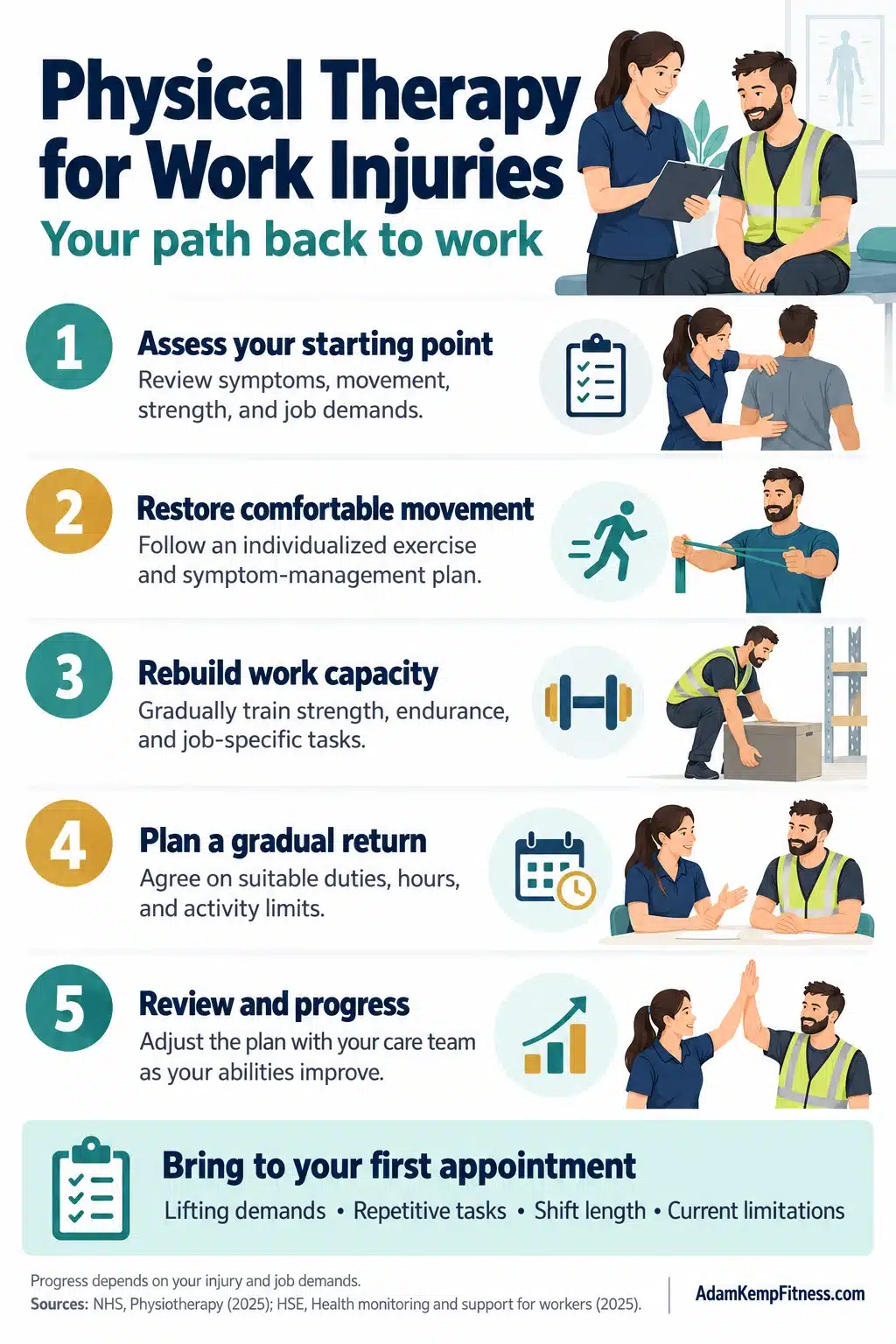
A rehabilitation program may move through the following three broad phases.
The pace and overlap depend on the injury, so think of these as a sequence rather than a timetable.
1.) Assessment That Starts With Your Job
Expect questions about how the injury happened, but also about your work in detail. How much do you lift, and how often?
Do you kneel, climb, reach overhead, drive, or hold one posture for hours?
A warehouse picker and an accountant with the same diagnosis may need different rehabilitation targets.
Your physical therapist may assess your movement, strength, balance, and how your symptoms respond to specific activities.
Together, you can use those findings to agree on clear functional goals.
2.) Managing Symptoms and Restoring Movement
Depending on your injury, early sessions may combine manageable exercises, advice about activity, and hands-on techniques.
The aim is to help you move more comfortably while establishing what your body can currently tolerate.
Your therapist should also explain which activities to modify and how to respond if symptoms increase.
That gives you a practical plan for the days between appointments.
3.) Rebuilding Capacity and Work Conditioning
As your capacity improves, rehabilitation may include progressive strengthening, mobility, movement control, and endurance work.
Later sessions can incorporate tasks that resemble your job, such as lifting from the floor to the waist, carrying loads, or working above shoulder height.
This stage helps connect rehabilitation exercises with the demands of a working day.
The relevant goal might be carrying a particular load safely or tolerating a task for longer without a sustained increase in symptoms.
If you already train, this approach may feel familiar.
Your therapist can adjust exercise load, repetitions, and recovery as your abilities change.
Bring This to Your First Appointment: A Job Demands Checklist
Most people describe their job in a sentence.
Your physical therapist can do far more with specifics, so consider jotting down:
- The heaviest thing you lift and roughly how often you lift it during a shift.
- How long you stand, sit, walk, or drive without a break.
- Any kneeling, crouching, climbing, or work above shoulder height.
- Repetitive movements, such as gripping tools, scanning, or typing.
- Shift length, overtime, and how many days in a row you work.
- Which tasks hurt most right now and which ones you can still manage.
- Whether lighter or modified duties are available.
This list turns a broad goal like “get back to work” into specific targets that can be discussed, trained, and measured.
How Is a Safe Return to Work Planned?
A return-to-work plan may involve reduced hours, modified duties, or temporary limits on particular tasks.
Workplace adjustments should reflect your individual condition and medical advice (HSE, 2025).
You may be able to return before every symptom has disappeared, provided the work is appropriate for your current abilities.
The key is agreeing on manageable duties and reviewing how you respond rather than relying only on a calendar date.
Here is a simplified example to discuss with your care team and employer:
| Stage | What Work Might Look Like | What to Review Before Progressing |
|---|---|---|
| Early | Shorter shifts, lighter tasks, frequent breaks | Whether duties stay within agreed restrictions and symptoms remain manageable |
| Building | Longer hours and selected usual tasks | How you tolerate the added workload during and after work |
| Near full | Most usual duties, with limits on the most demanding tasks | Whether job-specific capacity meets the next level of demand |
| Full duties | Usual role and hours | Whether you can consistently meet job demands and have any required clearance |
Your physical therapist can describe your current abilities in practical terms, which can help you and your employer discuss suitable duties.
Occupational health staff or your treating doctor may also need to contribute.
If a timeline feels faster than your body can handle, raise that concern early.
The process works best when restrictions, responsibilities, and review dates are clear.
Return to Work vs. Return to Training: Two Different Milestones
Being ready for your job does not automatically mean you are ready for heavy squats, sprint sessions, or contact sport.
The reverse can also be true because a short workout may place different demands on you than a full shift.
Return to work is measured against your job requirements, while return to training is measured against your exercise demands. A delivery driver, for example, might tolerate modified work before being ready for heavy deadlifts.
Discuss these practical points with your therapist:
- Ask which training is appropriate now. Get clear guidance about exercises, intensity, and any restrictions.
- Coordinate your total workload. Include work duties, gym sessions, and home rehabilitation when discussing how much activity you are doing.
- Keep recovery routines consistent. Discuss sleep or nutrition concerns if disrupted routines are making rehabilitation harder.
- Agree on a symptom response plan. Ask what discomfort is acceptable, when to reduce activity, and which changes need reassessment.
Common Work Injuries Physical Therapy May Help Treat
Physical therapy is used for a range of muscle, joint, and movement problems, including back pain, neck pain, sprains, and strains (NHS, 2025).
Examples relevant to workplace rehabilitation include:
- Low back strains or pain associated with lifting, twisting, or prolonged driving.
- Shoulder problems, including rotator cuff conditions affecting overhead work.
- Knee injuries following falls or awkward movements.
- Repetitive strain problems, such as elbow or wrist tendon pain.
- Neck pain aggravated by sustained positions or following an injury.
- Ankle sprains caused by slips, stairs, or uneven ground.
The diagnosis and severity determine which treatments are appropriate.
Some injuries require medical treatment alongside rehabilitation.
Mistakes That Can Complicate Recovery From a Work Injury
Managing a work injury can be challenging when you balance treatment, daily responsibilities, and pressure to return to work.
To get the most out of physical therapy for work injuries, watch for these common mistakes and discuss any barriers with your care team.
1.) Delaying Assessment When Symptoms Persist or Worsen
If pain is affecting your work, worsening, or limiting normal movement, arrange an appropriate assessment.
Identifying the problem helps you understand what to modify and what treatment may be needed.
2.) Not Reporting the Injury at Work
Follow your workplace’s injury-reporting procedure and check any relevant insurance or compensation requirements.
Keep a record of what happened, when symptoms began, and which tasks are affected.
3.) Resting Without a Plan for Resuming Activity
Ask your clinician how to balance protection with appropriate movement.
Restrictions vary by injury, particularly after a fracture, surgery, or significant tissue damage.
4.) Stopping Rehabilitation as Soon as Pain Improves
Before finishing treatment, review whether you have reached your functional goals.
5.) Skipping the Home Program
If your therapist prescribes home exercises, clarify how often to perform them and how to progress them.
Raise any barriers, such as pain, limited equipment, or difficulty fitting them around shifts.
6.) Ignoring the Mental Load
Lost income, uncertainty, and fear of reinjury can make the recovery process stressful.
Tell your therapist or doctor if these concerns are affecting your activity or confidence.
How to Choose a Physical Therapist for Work Injuries
Not every clinic has the same experience with occupational rehabilitation.
Before booking, consider asking:
- Do you regularly treat work-related injuries and help people return to work?
- Will my program include tasks relevant to my job?
- Can you provide written information about my functional abilities and restrictions?
- Do you work with the relevant compensation or insurance process?
- Will I receive a home exercise program and clear progress measures?
Check that the therapist holds the registration or license required where you live. Location, appointment availability, and cost also matter because your treatment plan needs to fit your circumstances.
A physiotherapy clinic close to home or work can make regular appointments easier to manage, so it is worth comparing a few nearby options before committing to one.
The best providers treat recovery as more than ticking boxes.
Look for clinics that offer wellness rehab for injured workers, combining clinical treatment, progressive exercise, and clear return-to-work planning, so the program is built around your injury and your job rather than a generic template.
When to See a Doctor First
Some symptoms require medical assessment before routine rehabilitation.
Seek emergency care for back pain accompanied by new bladder or bowel changes, numbness around the genitals or anus, or significant weakness or numbness in both legs (NHS, n.d.).
A serious accident, suspected fracture, or visible deformity also needs prompt assessment.
Tell a clinician about progressive weakness, fever, unexplained weight loss, or persistent nighttime pain so they can assess how significant those symptoms are.
Direct access to physical therapy depends on where you live and how you are paying for care.
Check whether your local service, insurer, or workplace compensation system requires a referral or authorization.
Frequently Asked Questions About Physical Therapy for Work Injuries
Final Thoughts: How to Build a Lasting Return to Work
A workplace injury is disruptive, and a clear plan can make the next steps easier to understand.
Report the injury, get an appropriate assessment, follow your agreed rehabilitation plan, and review your work duties as your abilities change.
The goal of physical therapy for work injuries is to help you rebuild the capacity your job requires.
Progress is most useful when it translates into tasks you can perform consistently throughout your working day.
This website does not provide medical advice. This website site does contain affiliate links, and purchases may earn a commission.
Read my Medical Disclaimer, Review Disclaimer, and Publishing Policies for more details. Use of this site indicates acceptance of these terms.
Check Out Some of My YouTube Videos Below, and Please Follow on YouTube for More Educational Health and Fitness Content!