

How to Make Time for Yourself Without Feeling Guilty
 Reading Time: 8 minutes
Learning how to make time for yourself starts with choosing a small part of the day to protect, and prayer is the first place I would begin.
A few quiet minutes to speak with Jesus Christ, express gratitude, and ask for guidance can give that time a meaningful purpose before you turn your attention to everything else.
As a professional basketball player, husband, and father, I understand how training, work, and family responsibilities can fill a schedule.
My faith is a crucial part of how I approach those demands, and I believe caring for yourself deserves a place alongside caring for the people who depend on you.
Jesus taught us to love and serve others, while also emphasizing the importance of stepping away to pray and rest, reminding us that we can make time for ourselves while remaining devoted to caring for others (Luke 5:16; Mark 6:31).
Research also supports making room for recovery during the day: a meta-analysis found that short breaks produced small improvements in energy and fatigue, although they did not consistently improve overall performance (Albulescu et al., 2022).
You can begin with prayer, a short walk, or a few uninterrupted minutes doing something you enjoy, then build a schedule that makes those opportunities easier to repeat.
The goal is to learn how to make time for yourself in a way that fits your responsibilities and gives your own needs consistent attention.
Why Is Making Time for Yourself Important?
Making time for yourself gives you space to rest, reflect, connect with God, and enjoy activities that matter to you.
When work and family responsibilities fill your schedule, protecting that space keeps your needs consistently in your day.
Even brief pauses can be useful: a meta-analysis found that short breaks helped reduce fatigue and improve feelings of energy, although they did not consistently improve performance (Albulescu et al., 2022).
The practical takeaway is that a break can be worthwhile simply because it helps you feel less depleted.
As a professional basketball player, husband, and father, I approach personal time with the same respect I give physical recovery.
When I plan my responsibilities, I give prayer, quiet reflection, and time to step away from daily demands the same consideration.
Personal time also gives you an opportunity to consider what you need before automatically accepting another commitment.
You can use those moments to identify an overwhelming responsibility, ask for help, or choose a healthy way to deal with stress that fits your situation.
Your time has value even when it does not produce a measurable result.
Reading for enjoyment, taking a peaceful walk, or spending a few minutes in prayer can be meaningful parts of your life without needing to earn their place through greater productivity.
Best Ways to Make Time for Yourself Without Feeling Guilty
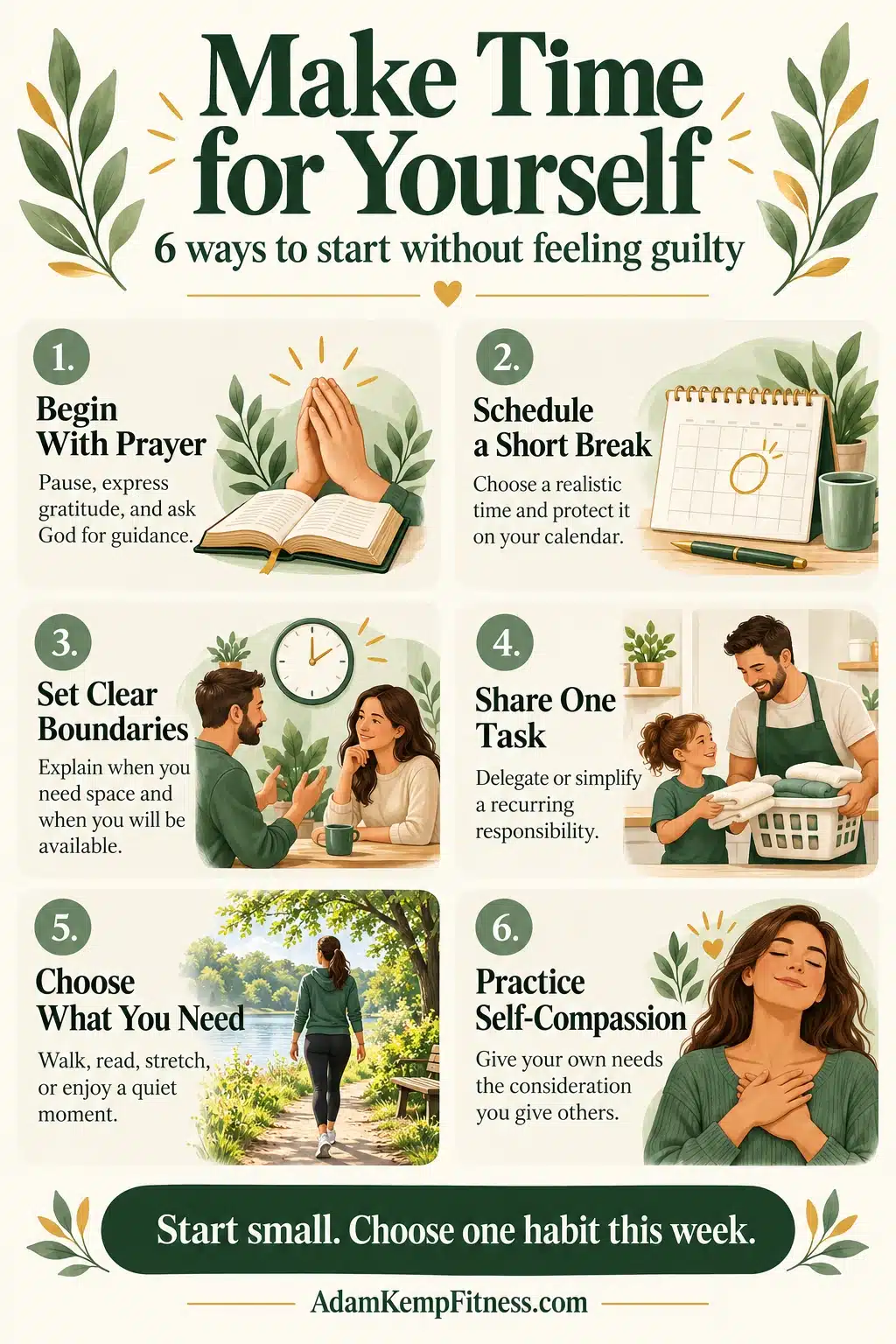
The best way to make time for yourself without feeling guilty is to choose a meaningful activity and make room for it within your responsibilities.
I recommend starting with prayer, then setting clear boundaries, sharing tasks, and taking small breaks to create time you can consistently enjoy.
Start Your Personal Time With Prayer
For me, prayer is a meaningful place to begin because it brings my attention back to God and the values that guide my decisions.
During difficult periods in my basketball career and recovery from injuries, faith has remained an important source of perspective.
One of the benefits of prayer I value most is having space to acknowledge what is weighing on me and ask for guidance.
You can bring those same intentions into a few quiet minutes at home, during a lunch break, or before bed.
Keep Your Prayer Time Simple
Choose a time when you can pause without immediately moving to the next task.
Put your phone aside, express gratitude for something specific, and speak honestly about whatever is on your mind.
You might pray for patience with your family, wisdom about a decision, or strength to handle a difficult day.
There is no need to turn this time into another demanding assignment; begin with a few minutes you can realistically protect.
Understand Why Taking Time for Yourself Feels Difficult
When you are used to being available, taking a break can feel uncomfortable even after you have handled your immediate responsibilities.
You may sit down to read or go for a walk while mentally listing everything you could be doing instead.
Before giving up that time, ask yourself a practical question: Does something need my attention now, or am I uncomfortable letting it wait?
A child who needs care and an email that can wait until tomorrow require different responses.
Give Yourself the Consideration You Give Other People
Think about how you would respond if your spouse, friend, or teammate said they needed a few minutes to themselves.
Use that same reasonable standard when deciding whether your own break is justified.
Research on self-compassion offers a useful perspective: across four experiments, treating personal mistakes with greater acceptance increased several measures of motivation to improve (Breines & Chen, 2012).
These experiments did not directly test guilt about personal time, but they challenge the assumption that being kinder to yourself necessarily weakens your effort.
You can care about your responsibilities while allowing yourself room to rest.
Your personal time also has value beyond how productive or helpful you become afterward.
Schedule Short Breaks Before Your Day Fills Up
To make personal time more consistent, decide when it will happen and what you want to do with it.
Implementation intentions, such as “I will take a ten-minute walk after lunch,” give you a concrete action to follow.
Short breaks are a reasonable starting point, especially on busy days, but give yourself more time when your schedule allows.
The micro-break research found that highly demanding tasks may require breaks longer than ten minutes for performance to recover (Albulescu et al., 2022).
Attach Your Break to Something You Already Do
Choose a familiar part of the day as your starting point: finish breakfast, then pray; close your laptop, then step outside; put away the dinner dishes, then read a few pages.
Keep an alternative available for days when plans change.
If your afternoon walk becomes impossible, you could protect a few quiet minutes later rather than abandoning personal time for the entire day.
For more ways to build breathing room into a demanding schedule, my guide on how to stress less covers practical habits you can adapt to your circumstances.
Set Clear Boundaries Around Your Time
Protecting personal time becomes more practical when the people around you understand when you will be available.
Explain what you need, how long you will be away, and how you’ll cover shared responsibilities.
For example, you could say, “I would like twenty minutes to walk after dinner, and then I can handle bedtime.” That gives your family a clear plan and makes room to discuss their needs too.
Make Personal Time Fair Within Your Household
If you live with a partner or share caregiving responsibilities, plan opportunities for everyone to have a break.
Agree on who is responsible during that period so the person resting can actually step away.
Children’s needs and unexpected problems will sometimes interrupt the plan.
When that happens, look for another opportunity instead of treating one interruption as a reason to stop protecting your time.
Hand Off or Simplify One Recurring Task
To create more space in your week, look for a responsibility that can be shared, simplified, or removed.
Start with something specific, like alternating dinner prep, combining errands, or asking a coworker to own an appropriate task.
Delegation works best when the other person understands the responsibility and has the time and ability to manage it.
Agree on what needs to be done, then give them room to complete it without constant supervision.
Consider Where Paying for Help Makes Sense
If your budget allows, occasional help with cleaning, grocery delivery, or another time-consuming chore may be worth considering.
In a field experiment, working adults reported greater happiness after spending money on a time-saving purchase than after a material purchase (Whillans et al., 2017).
The practical question is whether the expense frees time you value without adding financial pressure.
Sharing household work and simplifying expectations are also options when paying for help does not fit your budget.
Once you create that opening, decide how you want to use it before filling it with another obligation.
Asking for help is one of several healthy ways to deal with stress that can make your schedule more manageable.
Choose Activities That Match What You Need
Personal time can serve different purposes depending on the day.
You might want quiet after hours of conversation, gentle movement after sitting at a desk, or time to enjoy a hobby without tracking your progress.
Start by asking what you would appreciate most right now. Reading, listening to music, stretching, or sitting outside are all possibilities you can try without building an elaborate routine.
Spend Some of Your Time Outdoors
A walk through a park or another green space is one option worth exploring.
In a controlled study, participants who took a 90-minute nature walk reported reduced repetitive negative thinking, while those who walked in an urban setting did not show the same improvement (Bratman et al., 2015).
That study does not establish that a short neighborhood walk produces identical results, but it gives a useful reason to consider your surroundings when choosing where to spend a longer break.
On a busy day, choose a route and duration that fit your available time.
Give Yourself a Clear Stopping Point for Work
Before taking a break, write down the next task you need to handle and when you will return to it.
Then close your work tabs, silence nonessential notifications, and begin the activity you chose.
You can also explore progressive muscle relaxation if you prefer a structured activity during quiet time.
The key is to choose deliberately, rather than automatically, to spend every available minute answering messages.
Products such as high THCa flower might provide a form of relaxation, but they should not be treated as a requirement for winding down or a proven solution to stress.
Cannabis can cause anxiety or paranoia, and smoking it can harm lung tissue, so it deserves separate consideration from everyday relaxation habits (Centers for Disease Control and Prevention, 2024a, 2024b).
Final Thoughts: Give Your Own Needs a Place in Your Day
Learning how to make time for yourself becomes more practical when you choose one activity, decide when it fits, and communicate what you need.
I recommend starting with prayer, then making room for a walk, a book, or another activity you enjoy.
You may still feel some guilt at first, especially if you are accustomed to putting yourself last.
Give yourself permission to follow a reasonable plan while continuing to care for your family, work, and other commitments.
Start with a small amount of time you can protect this week, then adjust based on what works.
Consistent opportunities to pause are a practical foundation for learning how to make time for yourself without feeling guilty.
This website does not provide medical advice. This website site does contain affiliate links, and purchases may earn a commission.
Read my Medical Disclaimer, Review Disclaimer, and Publishing Policies for more details. Use of this site indicates acceptance of these terms.
Check Out Some of My YouTube Videos Below, and Please Follow on YouTube for More Educational Health and Fitness Content!