
Stress Relief Practices: Simple Daily Habits for a Calmer Mind
 Reading Time: 5 minutes
 Stress relief practices are intentional habits, such as gentle breathing exercises, mindfulness, and setting aside quiet time, that help you create space to relax and manage everyday demands.
When work, family responsibilities, and a busy schedule compete for your attention, these practices offer a practical starting point for making your own well-being part of the day.
Research supports the potential benefits of certain relaxation practices, including a meta-analysis that linked breathwork to modest reductions in self-reported stress, although limitations in study quality mean the results deserve a measured interpretation (Fincham et al., 2023).
As a professional basketball player and father, I have to balance the demands of training and competition with travel and family life, so I value daily wellness habits that fit into a changing schedule.
For me, a useful place to start is a familiar activity, such as a few minutes of gentle breathing, prayer, or quiet time before bed.
To make wellness practices for stress relief part of your routine, choose one or two activities you enjoy and identify a realistic time to practice them.
Whether that means taking a mindful break between tasks or creating a peaceful corner at home, the goal is to build a repeatable routine around stress relief practices.
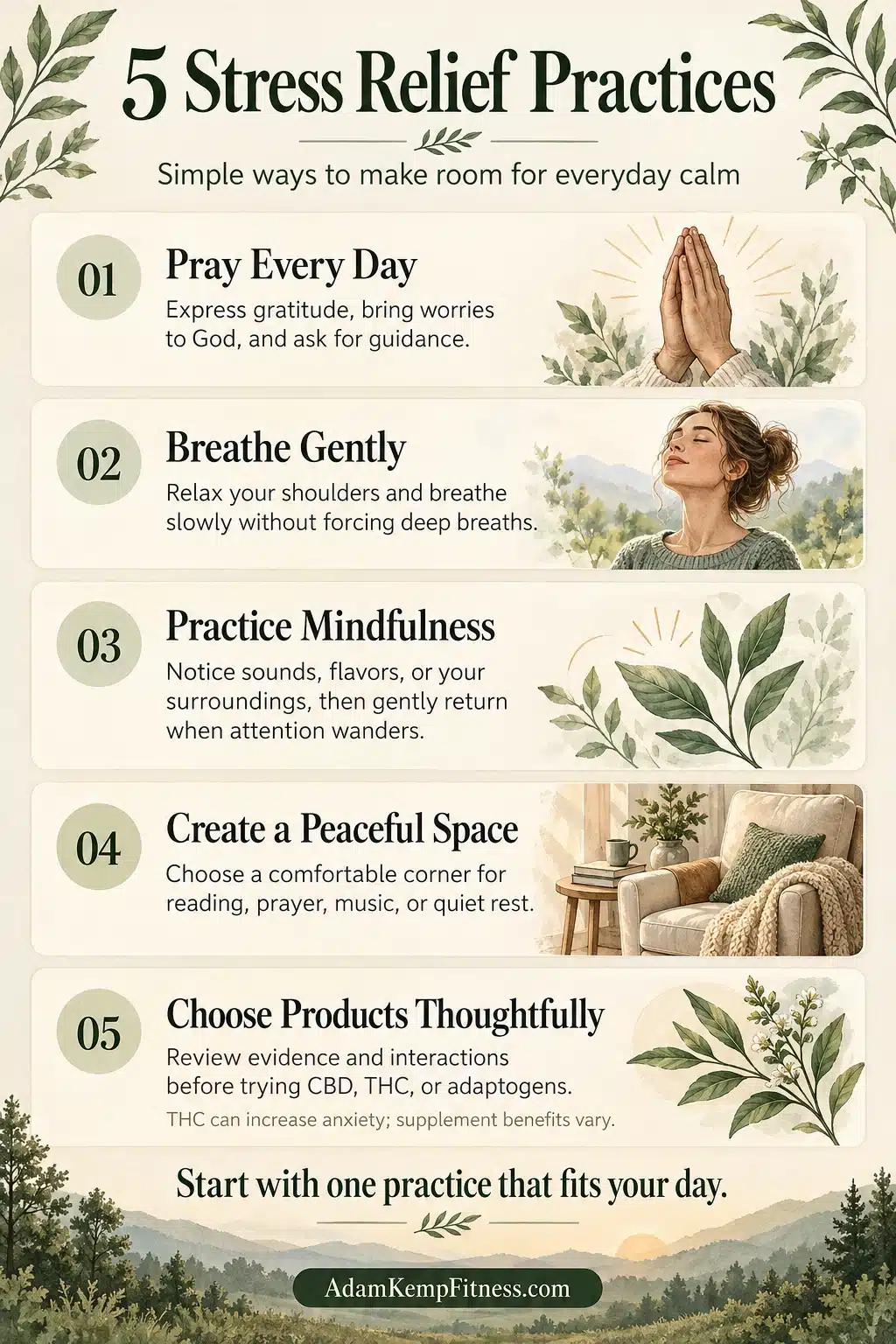
Take Time to Pray Every Day
As a Christian, I include prayer in my stress-relief practices because my faith is central to how I approach challenges.
Daily prayer offers a meaningful opportunity to pause, express gratitude, and bring worries to Jesus.
You can use this time to reflect on what feels overwhelming, ask for guidance, or pray for someone you care about.
I find value in making room for that connection amid the responsibilities of basketball, travel, and family life.
To make prayer part of your daily wellness habits, choose a familiar moment, such as after waking up, during a quiet walk, or before bed.
You might use a traditional prayer, reflect on a passage of Scripture, or speak honestly about whatever is on your mind.
When you are unsure where to begin, try naming something you are grateful for, something you need help navigating, and someone you want to support.
Let that reflection guide both your prayer and a practical next step, whether that means reaching out to a loved one, asking for help, or approaching a difficult conversation with greater patience.
Consider Products That Support Relaxation
When exploring products to complement your stress relief practices, consider the ingredients, available research, and how they fit your needs.
CBD is a nonintoxicating cannabinoid with preliminary evidence for anxiety relief, although research has not established that everyday retail products reliably reduce stress (National Center for Complementary and Integrative Health [NCCIH], n.d.-a).
THC produces an intoxicating high that some adults find relaxing, but it can also increase anxiety and impair attention, particularly at higher doses (Health Canada, n.d.).
Products such as THCA concentrate deserve particular care because heating converts THCA into intoxicating THC (Canadian Food Inspection Agency, n.d.).
Beyond cannabinoids, adaptogens such as ashwagandha and rhodiola are marketed to support the body’s response to stress, although the evidence differs between ingredients.
Some ashwagandha preparations may help with stress and sleep, while reliable evidence supporting rhodiola remains insufficient (NCCIH).
If you choose to try these products, look for independent testing of potency and contaminants, follow local cannabis laws, and review potential medication interactions with a pharmacist or clinician.
Explore my article on natural remedies for stress for a better look at how nutrition, herbal teas, and everyday healthy habits can fit into your approach alongside any products you choose.
Practice Breathing Exercises
One of the simplest stress relief practices is to pause and pay attention to your breathing.
Find a comfortable place to sit, relax your shoulders, and breathe gently in and out without forcing a deep breath or rushing the rhythm.
Research suggests that breathing exercises may help reduce self-reported stress, making them a practical addition to your daily wellness habits (Fincham et al., 2023).
Try practicing for a few minutes at home, in a quiet corner of your office, or before going to sleep.
Choose a time that fits naturally into your schedule so you have a regular opportunity to pause and unwind.
Practice Mindfulness
Mindfulness means paying attention to the present moment with curiosity and without immediately judging what you notice.
You can practice by observing your breathing, your surroundings, or your feelings as they arise.
For example, notice the flavor of your food, listen to sounds outside, or feel the warmth of sunlight on your skin.
When your attention shifts to yesterday’s worries or tomorrow’s responsibilities, gently bring it back to the experience in front of you.
Research on structured mindfulness programs suggests they can reduce psychological distress compared with taking no action, although benefits vary across people and settings (Galante et al., 2021).
Start by making one familiar activity, such as drinking your morning tea, a mindful moment by not checking your phone.
As you learn how to stress less, use these mindful pauses to notice recurring sources of pressure and consider what you could change, such as setting aside time away from your phone or adjusting an overloaded schedule.
Create a Peaceful Space at Home
To make room for relaxation at home, choose a comfortable corner where you can step away from work, household tasks, and digital distractions.
Keep the setup simple, with a supportive chair, soft lighting, and a few personal touches that make the space inviting.
Add some books, favorite artwork, or prints of characters you find comforting, and consider playing music you enjoy.
Research suggests that music interventions can reduce psychological and physiological stress measures, supporting music as an option for your relaxation routine (de Witte et al., 2020).
Spend a few minutes there reading, praying, practicing gentle breathing, or simply resting. Use this space as a regular reminder to take a break and make time for your stress relief practices.
Final Thoughts: How to Make Time for Everyday Calm
To make stress relief practices part of your everyday life, begin with one habit that fits your needs and schedule.
To build on these practices, consider other healthy ways to deal with stress, including making time for exercise, maintaining a consistent sleep schedule, and sharing responsibilities when your workload becomes overwhelming.
You might spend a few minutes praying in the morning, practice gentle breathing between tasks, or settle into a quiet corner to read before bed.
With basketball, travel, and family responsibilities shaping my schedule, I value opportunities to pause and reconnect with my faith and the people closest to me.
When choosing your own daily wellness habits, think about what gives that time meaning and when you can realistically make room for it.
As you explore different approaches, pay attention to which activities you enjoy and want to return to.
Build your routine around those stress relief practices, allowing it to adapt as your responsibilities and needs change.
This website does not provide medical advice. This website site does contain affiliate links, and purchases may earn a commission.
Read my Medical Disclaimer, Review Disclaimer, and Publishing Policies for more details. Use of this site indicates acceptance of these terms.
Check Out Some of My YouTube Videos Below, and Please Follow on YouTube for More Educational Health and Fitness Content!
![Subscribe to @AdamKempFitness for more training, general health, recovery, and nutrition tips from a professional basketball player with a master’s degree in Nutrition Education! 🏀💪
Seated Max Vertical Jumps From a Box are one way I train explosive takeoff power with maximum intent on every rep.
Starting seated, with a pause and minimal rocking or dipping, reduces the contribution of a quick countermovement and emphasizes producing force from a relatively static position (National Strength and Conditioning Association [NSCA], 2020).
For athletes, the training goal is explosive lower-body force production and coordinated extension through the hips, knees, and ankles. I use this variation to practice driving hard into the floor and accelerating my body upward.
My preferred setup: 3 sets of 3 reps or 4 sets of 2 reps, supersetted with a strength or power exercise.
I keep the reps low, reset between jumps, and take longer rest periods so I’m ready to attack every takeoff. Even when pairing exercises, I give myself enough recovery to keep the jumps sharp.
Every rep has one goal: jump as high as possible. I focus on an explosive takeoff, a controlled landing, and consistent quality throughout the session.
Save this for your next power workout! 🚀
Reference: NSCA. (2020). Stretch-shortening cycle.
#VerticalJump #JumpTraining #ExplosivePower #AthleticPerformance #BasketballTraining](https://www.adamkempfitness.com/wp-content/plugins/feeds-for-youtube/img/placeholder.png)