Is Walking the Best Exercise for Seniors?
 Reading Time: 9 minutes
 Walking is perhaps the easiest exercise to add to your routine once you reach 60. You can walk almost anywhere, and it is free and easy to do.
But is walking the best exercise for seniors, or should it be one part of a more complete routine?
Walking is an excellent starting point, but older adults also need activities that challenge their strength and balance (Centers for Disease Control and Prevention [CDC], 2025).
Walking helps you get moving, but it alone doesn’t fully build the functional strength you need for everyday activities like lifting and standing up.
It also does not replace exercises specifically designed to improve balance and reduce falls (National Institute on Aging [NIA], 2025).
Because of this, walking should not be the only exercise older adults consider.
Instead, a well-rounded approach to healthy aging includes maintaining the physical abilities that support your independence.
Key Takeaways: When asking “Is walking the best exercise for seniors?”, distinguish walking’s health benefits for seniors from the need for other exercises, and make sure your routine supports the different ways you need to move throughout the day.
As a professional basketball player with a master’s degree in Nutrition Education, I share research-informed information to help you make practical health and fitness decisions. This article is educational and does not replace individualized advice from your doctor or physical therapist.
Is Walking Considered the Best Exercise for Seniors?
Walking is often considered one of the most practical exercises for seniors because it requires little equipment and can fit into everyday life.
You can walk with a friend, take a short trip around your neighborhood, or choose an indoor route when the weather makes outdoor exercise difficult.
However, “best” depends on what you want an exercise to accomplish.
Walking can be your preferred aerobic activity, while strength, balance, and flexibility exercises address other needs.
What are the Best Types of Exercise for Seniors?
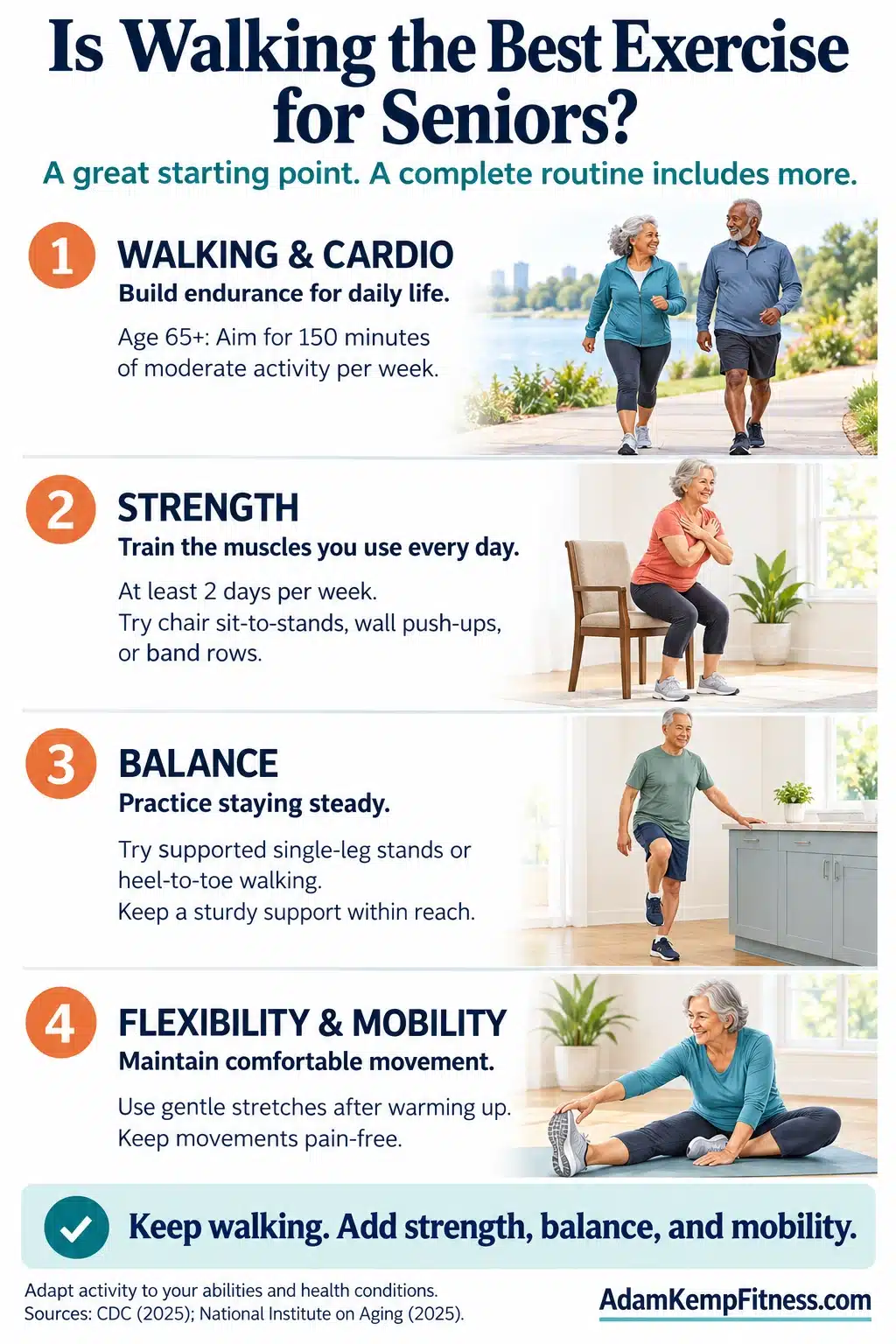
To remain mobile and active for as long as possible, adults 65 and older should include aerobic exercise, muscle-strengthening exercise, and balance activities in their weekly routines (CDC, 2025).
Flexibility is also useful, particularly when stiffness makes everyday movement harder.
Stretching can help maintain the range of motion needed for activities such as tying your shoes or reaching into a cupboard (NIA, 2025).
For practical planning, think about four areas: aerobic fitness, muscle strength, balance, and flexibility or mobility.
Walking can anchor your routine, while other activities help round it out.
1.) Aerobic Exercise: Walking for Heart Health and Endurance
Walking is an excellent starting point for many older adults because it is low-impact.
Cardio exercises, including both anaerobic and aerobic exercise, increase your heart rate and breathing.
Aerobic exercise is safer for seniors than anaerobic exercise; other examples include dancing, swimming, and cycling.
These activities offer different ways to include aerobic movement when you want variety or when walking is uncomfortable (NIA, 2025).
The weekly guideline for older adults is at least 150 minutes of moderate-intensity aerobic activity, 75 minutes of vigorous activity, or an equivalent combination.
Brisk walking is one option for meeting the moderate-intensity target (CDC, 2025).
The goal of many older adults should be to increase their cardiovascular endurance so they can better participate in day-to-day activities.
Imagine shopping for an extended period without getting tired or falling behind friends on an outing.
Activities such as walking, swimming, or cycling should be matched to your current abilities.
If the recommended amount is more than you can manage, being as active as your health allows is still worthwhile (CDC, 2025).
Instead of treating every walk as a test, choose a route and pace that fit your starting point.
A familiar loop near home may be easier to repeat consistently than an ambitious route that feels overwhelming.
For someone who enjoys recreational activity, pickleball for seniors is another way to get aerobic exercise that is worth exploring.
Playing outdoor sports for seniors, like pickleball, offers additional benefits beyond aerobic exercise.
The right choice depends on your interests, current fitness, and ability to manage the movements involved.
So, is walking the best exercise for seniors who want an accessible aerobic routine?
It can be an excellent choice, but that doesn’t make it a replacement for the rest of your exercise plan.
2.) Strength Training: Build the Muscle You Use Every Day
Many older adults do not include this part of the workout.
Walking gets you moving, but resistance training provides a more direct way to challenge muscle strength.
Just think about some of the things you do in a day.
You use your muscles to get out of bed, stand up from a seat, carry groceries, climb stairs, lift a basket of laundry, or reach for something on a top shelf.
All of these tasks involve muscle strength.
Strengthening exercises can make everyday activities, including stair climbing and carrying groceries, easier to perform (NIA, 2025).
Strength training doesn’t necessarily mean going to a gym and lifting heavy weights.
It can mean using your body weight or resistance from exercise machines, bands, and dumbbells.
Some basic exercises are:
- Sit-to-stands from a sturdy chair.
- Wall push-ups.
- Resistance band rows.
- Step-ups.
- Heel raises.
- Light dumbbell exercises.
You don’t need to start with every exercise on the list. Treat these as options to discuss with a qualified trainer or physical therapist if you are unsure which movements fit your needs. Although these exercises are a good starting point, targeted physical therapy for seniors, along with a well-designed workout program, can be especially effective for improving quality of life and mobility.
For a better look at building a sustainable routine, my guide to strength training for longevity explains how to approach strength with long-term function in mind.
The relationship between strength training and falls also deserves attention.
A 2021 systematic review included five randomized controlled studies involving 543 older adults and found no clear difference in falls between strength training and other exercise programs (Claudino et al., 2021).
The certainty of that evidence was very low, so it does not establish that strength training alone is the best approach to preventing falls.
It also does not mean that building strength lacks value.
Muscle-strengthening activities should be performed at least twice a week and work the major muscle groups, including the legs, hips, back, abdomen, chest, shoulders, and arms (CDC, 2025).
3.) Balance Exercises: Practice Staying Steady
We often do not appreciate good balance until we lose it.
We can become unbalanced in many ways throughout the day, such as stepping onto an uneven surface or stumbling while turning.
However, you can practice balance with a variety of exercises, including standing on one leg with support, walking heel-to-toe, side-stepping, and controlled turns.
Improving balance does not always involve moving forward.
It may require holding a position or controlling movement in different directions.
That is one reason walking and balance training should not be treated as interchangeable.
A familiar walk and a carefully chosen balance exercise ask your body to solve different movement challenges.
A large Cochrane review found that balance and functional exercise programs reduced the rate of falls by approximately 24% among older adults living in the community.
Programs combining several exercise types, commonly balance and functional exercises with resistance training, probably reduced fall rates as well (Sherrington et al., 2019).
The review found insufficient evidence to establish the effects of walking-only programs on falls.
This distinction matters when answering whether walking is the best exercise for seniors whose main concern is staying steady.
It is important to practice balance exercises safely. If you feel unsteady, do not practice a challenging exercise in the middle of a wide-open space.
Keep a supporting surface, such as a counter or sturdy chair, within reach and use it as needed.
Start with easier activities and seek guidance when you are uncertain about a movement (NIA, 2025).
4.) Flexibility and Mobility: Make Everyday Movement Easier
Being able to move your joints through a comfortable range of motion matters for everyday function.
This is where flexibility and mobility exercises become useful.
Examples of movement limitations can show up when putting on your shoes, reaching behind you, getting up from the floor, or raising your arms overhead, as these activities require more than the ability to walk around the block.
Improving and maintaining flexibility can be accomplished with a variety of types of stretching and mobility exercises.
You should always stretch when your muscles are warmed up, keep breathing normally, and avoid stretching to the point of pain (NIA, 2025).
Other mobility work can involve controlled joint movements and gentle dynamic stretching.
The focus should be on comfortable movement that fits your needs rather than forcing yourself into a particular position.
There is also evidence that stretching may help certain aspects of walking performance.
A 2025 systematic review included 29 studies, and its meta-analysis of six studies involving 139 participants found improved walking speed compared with groups assigned no exercise (Salse-Batán et al., 2025).
These findings suggest that flexibility work can complement a walking routine, but they do not show that stretching replaces strength or balance training.
The main goal is to have enough comfortable range of motion to perform daily activities.
You do not need to achieve extreme flexibility for movement practice to have a practical purpose.
Is Walking the Best Exercise for Seniors Over 50 or 60?
If you are asking, “Is walking the best exercise for seniors over 50?” the same practical distinction applies: walking can be a useful foundation, but your routine should reflect more than your age.
Turning 50 or 60 does not tell you exactly which exercises you can do or how challenging they should be.
Consider what you can do comfortably now, what you enjoy, and which everyday activities you want to make easier.
The CDC recommendations discussed above specifically address adults 65 and older, but someone in their 50s or early 60s should not assume that the label “senior exercise” automatically defines their abilities.
My guide to exercise for seniors offers additional ideas for thinking through a manageable routine. Use your starting point and individual needs to guide your choices.
Think Beyond Walking: A Simple Weekly Exercise Routine for Seniors
The good news is that you do not need four completely separate workouts to cover the different types of exercise.
You can include several activities in the same session or spread them throughout the week.
You can walk most days and schedule strength workouts on two separate days.
Between or after workouts, you could practice balance and mobility.
For example, someone already comfortable with regular exercise could organize the week like this:
- Monday: Walking and a strength workout.
- Tuesday: Walking and supported balance practice.
- Wednesday: Walking and gentle flexibility work.
- Thursday: Walking and a strength workout.
- Friday: Walking and supported balance practice.
- Saturday: An enjoyable activity and comfortable mobility work.
- Sunday: Rest or easy movement, depending on how you feel.
This is an example of how to organize activities, not a requirement to exercise every day.
Adjust the duration, challenge, and number of sessions to your circumstances.
You do not need to get complicated to have a varied schedule.
What matters is finding an approach that works with your constraints and that you will actually follow.
Final Thoughts: Is Walking the Best Exercise for Seniors?
Walking is one of the most practical ways to stay active and an effective form of safe fitness for seniors, but the best exercise routine for seniors usually includes more than walking.
You should keep it as a regular healthy habit while making room for strength, balance, and comfortable mobility work.
Being able to take a stroll around the block is a meaningful part of healthy aging, but the bigger goal is also having the physical ability to do household chores and enjoy the activities that matter to you.
If a health condition, recent injury, or balance problem makes exercise uncertain, ask a healthcare professional for help choosing an appropriate starting point.
You can also explore my healthy aging resources for related articles.
This website does not provide medical advice. This website site does contain affiliate links, and purchases may earn a commission.
Read my Medical Disclaimer, Review Disclaimer, and Publishing Policies for more details. Use of this site indicates acceptance of these terms.
Check Out Some of My YouTube Videos Below, and Please Follow on YouTube for More Educational Health and Fitness Content!
![Subscribe to @AdamKempFitness for more training, general health, recovery, and nutrition tips from a professional basketball player with a master’s degree in Nutrition Education! 🏀💪
Seated Max Vertical Jumps From a Box are one way I train explosive takeoff power with maximum intent on every rep.
Starting seated, with a pause and minimal rocking or dipping, reduces the contribution of a quick countermovement and emphasizes producing force from a relatively static position (National Strength and Conditioning Association [NSCA], 2020).
For athletes, the training goal is explosive lower-body force production and coordinated extension through the hips, knees, and ankles. I use this variation to practice driving hard into the floor and accelerating my body upward.
My preferred setup: 3 sets of 3 reps or 4 sets of 2 reps, supersetted with a strength or power exercise.
I keep the reps low, reset between jumps, and take longer rest periods so I’m ready to attack every takeoff. Even when pairing exercises, I give myself enough recovery to keep the jumps sharp.
Every rep has one goal: jump as high as possible. I focus on an explosive takeoff, a controlled landing, and consistent quality throughout the session.
Save this for your next power workout! 🚀
Reference: NSCA. (2020). Stretch-shortening cycle.
#VerticalJump #JumpTraining #ExplosivePower #AthleticPerformance #BasketballTraining](https://www.adamkempfitness.com/wp-content/plugins/feeds-for-youtube/img/placeholder.png)