

Jump Squats: Benefits, How to Do, Muscles Worked & Pro Tips
 Reading Time: 13 minutes
 Jump squats are one of my all-time favorite exercises because they combine a squat with an explosive vertical jump, challenging your quads, glutes, and calves while your core stabilizes the movement.
Although you can probably determine some of the benefits of jump squats on their own, I believe this article will be very important for you because it will also help you understand the muscles worked, and proper technique can help you decide how to include them in your workouts.
As a professional basketball player, I’ve used jump squats in my training for years because they offer a practical way to build explosive power, whether you’re starting with bodyweight reps or progressing to weighted variations.
Science supports these claims as well: research suggests that structured jump squat training can improve jumping ability, strength, and sprint performance, though results depend on the training program and the individual athlete (Vanderka et al., 2016).
To get the most from the jump squat exercise, choose an appropriate variation and load while landing with control.
Watch my video below to see some of my favorite jump squat variations, and subscribe to my YouTube channel for more practical training advice. Then read the rest of this article as well to explore the muscles worked, key benefits, and how to do jump squats with proper form!
What Are Jump Squats?
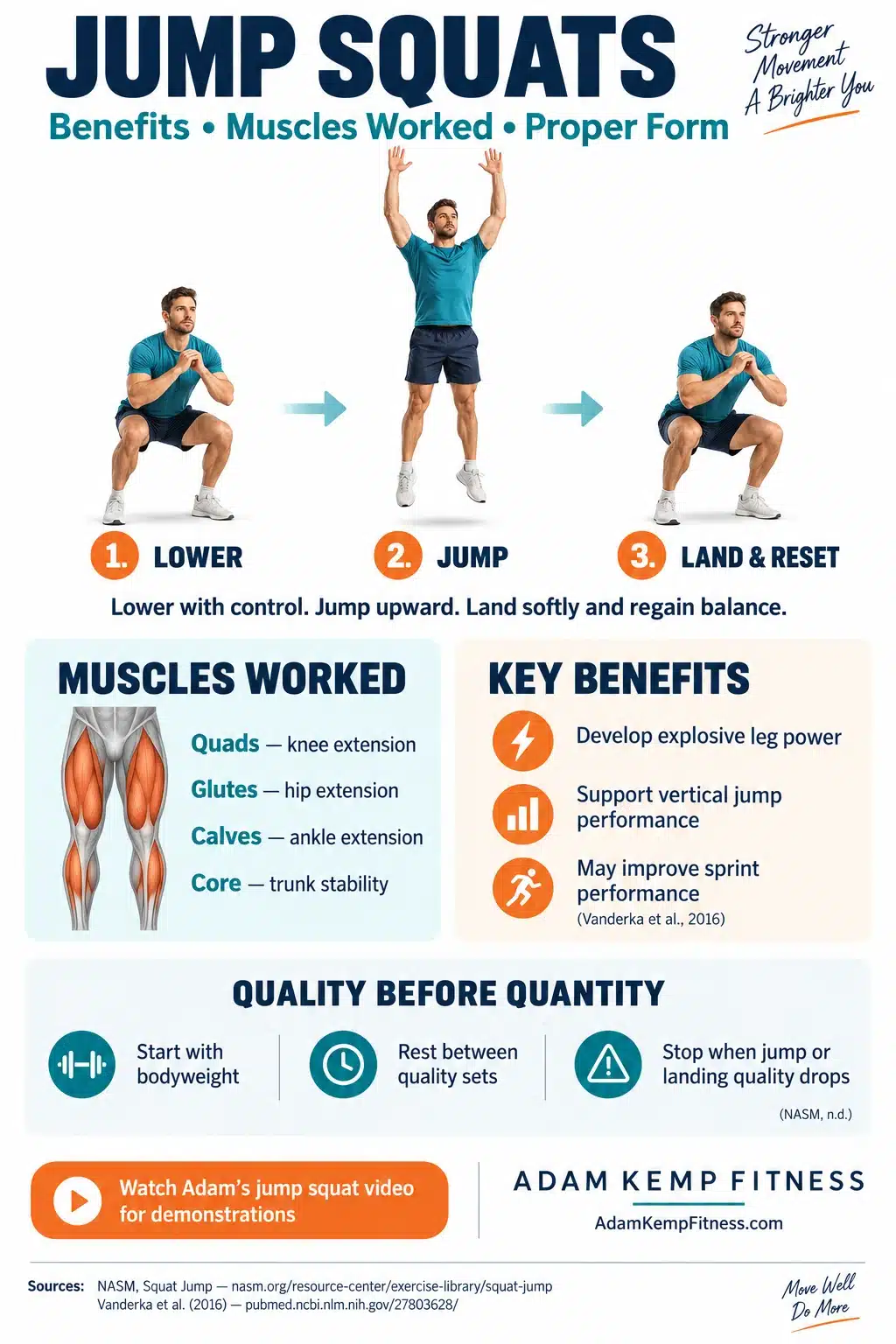
Jump squats are an explosive lower-body exercise that combines a squat with a vertical jump.
You lower your body by bending your hips and knees, then extend your hips, knees, and ankles to propel yourself off the ground before landing with control (National Academy of Sports Medicine [NASM], n.d.).
The primary muscles worked during jump squats include the quadriceps, glutes, and calves, while your core helps stabilize your torso.
This coordinated movement emphasizes producing force quickly, making jump squats a useful exercise for developing lower-body power.
You can perform jump squats using your body weight or added resistance, depending on your experience and training goals.
Repetitions can include a deliberate reset after each landing or a continuous rhythm, as long as you maintain balance and controlled technique.
Jump Squats Muscles Worked: What Muscles Do Jump Squats Work?
Jump squats are a highly effective, multi-joint exercise targeting several muscle groups, primarily in the lower body:
- Quadriceps: These muscles on the front of your thighs are responsible for extending your knees during the explosive upward jump.
- Hamstrings: Located at the back of your thighs, these muscles control the downward phase of the movement.
- Glutes: The largest muscles in your buttocks drive hip extension, crucial for power generation.
In addition to these primary muscles, jump squats engage:
- Core Muscles: Including the rectus abdominis, obliques, and lower back, which stabilize the spine and maintain proper form.
- Upper Body Muscles: Such as the deltoids and trapezius, which contribute to arm movement and overall balance.
This comprehensive muscle engagement makes jump squats a full-body exercise that enhances both strength and coordination.
Benefits of Jump Squats: What Do Jump Squats Do?
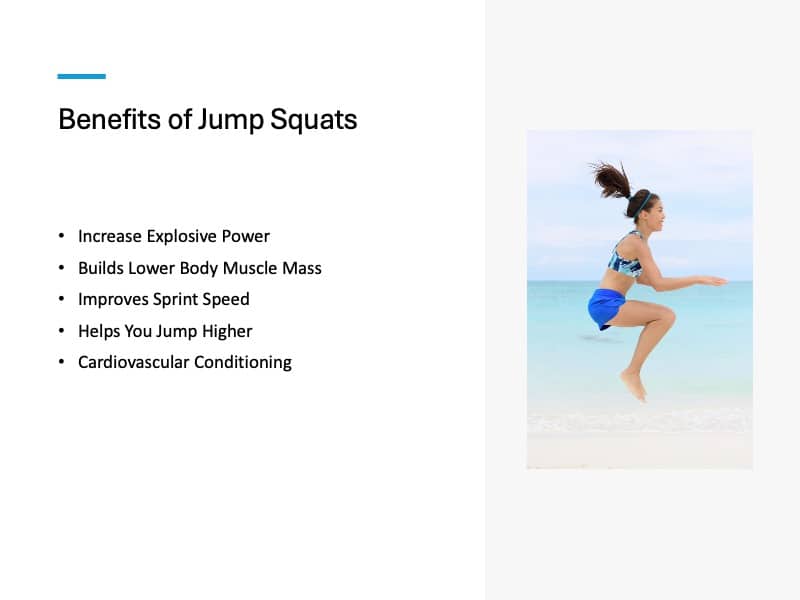
Jump squats deliver a range of benefits that go beyond basic strength training. Here’s a deeper look at why they deserve a spot in your fitness routine:
Increase Explosive Power
Jump squats are an incredibly effective exercise for building explosive power in the legs, making them a valuable addition to any workout routine.
While powerful legs are particularly beneficial for athletes, they also benefit anyone committed to exercising regularly.
In fact, developing explosive power through jump squats can carry over to other exercises, such as the back squat or deadlift, allowing individuals to lift more weight and set new personal records.
Additionally, adding jump squats to your routine can help break through weight-lifting plateaus.
When you perform the same exercises over and over again, your muscles can adapt and become accustomed to the workload, making it more difficult to continue making progress.
By regularly challenging your muscles with this explosive exercise, you’ll not only build power but also improve overall muscle responsiveness and efficiency.
This benefit extends beyond athletic performance to daily activities, such as climbing stairs or lifting heavy objects, where explosive strength plays a crucial role.
Builds Lower Body Muscle Mass
Though not traditionally considered a hypertrophy exercise, jump squats stimulate lower body muscle growth by forcing muscles to work at maximum capacity.
The intense nature of jump squats recruits fast-twitch muscle fibers, which are critical for both explosive power and muscle size.
For optimal results:
- Perform high-rep jump squats for endurance and hypertrophy.
- Use light weights to emphasize eccentric loading for muscle-building benefits.
Studies show weighted jump squats can enhance muscle architecture and improve braking ability, a key factor in athletic performance.
Also, research suggests that when performing jump squats, the difference in force between the legs will be negligible, even if you have imbalances in your lower body.
Weighted variations create greater tension in the muscles, particularly during the eccentric (lowering) phase, which is vital for muscle growth.
Additionally, the controlled landing in jump squats helps strengthen stabilizing muscles around the knees and hips, reducing the risk of injury and improving functional strength for other exercises and activities.
Improves Sprint Speed
Sprinting is a highly specific activity that requires a combination of power, speed, and agility.
If you want to improve your sprinting speed, incorporating jump squats into your workout routine may be a game-changer.
Research has shown that maximal concentric jump power is closely related to sprint acceleration, which means that building explosive power in the legs through jump squats can translate to improved sprinting speed.
In fact, a study published in the European Journal of Applied Physiology found that concentric force development is critical to sprint start performance, further emphasizing the importance of explosive power in the legs.
Another study published in Human Movement found that the height and power produced during the squat jump is the best predictor of sprinting speed.
Incorporating jump squats into your workout routine can help build explosive power in the legs, leading to improved sprinting speed and performance.
Helps You Jump Higher
Jump squats directly improve vertical jump height by training the fast-twitch muscle fibers responsible for explosive movement.
Whether for sports or personal goals, this exercise enhances your ability to generate upward force efficiently.
- By consistently practicing jump squats, you’ll not only strengthen the muscles required for jumping but also improve your neuromuscular coordination.
- This coordination is essential for transferring power from your lower body to your upper body, allowing for a more synchronized and effective jump.
Athletes in sports like basketball, volleyball, and track and field particularly benefit from this improvement, as it can give them a competitive edge.
If you want to increase your vertical jump, start doing more jump squats!
Cardiovascular Conditioning
Jump squats provide an excellent cardiovascular workout when incorporated into high-intensity training protocols.
Their explosive nature elevates heart rate rapidly, making them a fantastic addition to interval training or circuit-based workouts. For example:
- Tabata Jump Squats: Performing jump squats in a Tabata workout format (20 seconds of work followed by 10 seconds of rest for 4 minutes) delivers an intense cardio challenge that burns calories and builds endurance.
- Circuit Training: Including jump squats in a circuit with other exercises like push-ups, mountain climbers, and burpees creates a dynamic workout that targets multiple fitness components simultaneously.
This combination of strength and cardio benefits not only improves heart health but also builds stamina and overall conditioning, making jump squats an efficient, effective addition to any fitness routine.
How to Do Jump Squats
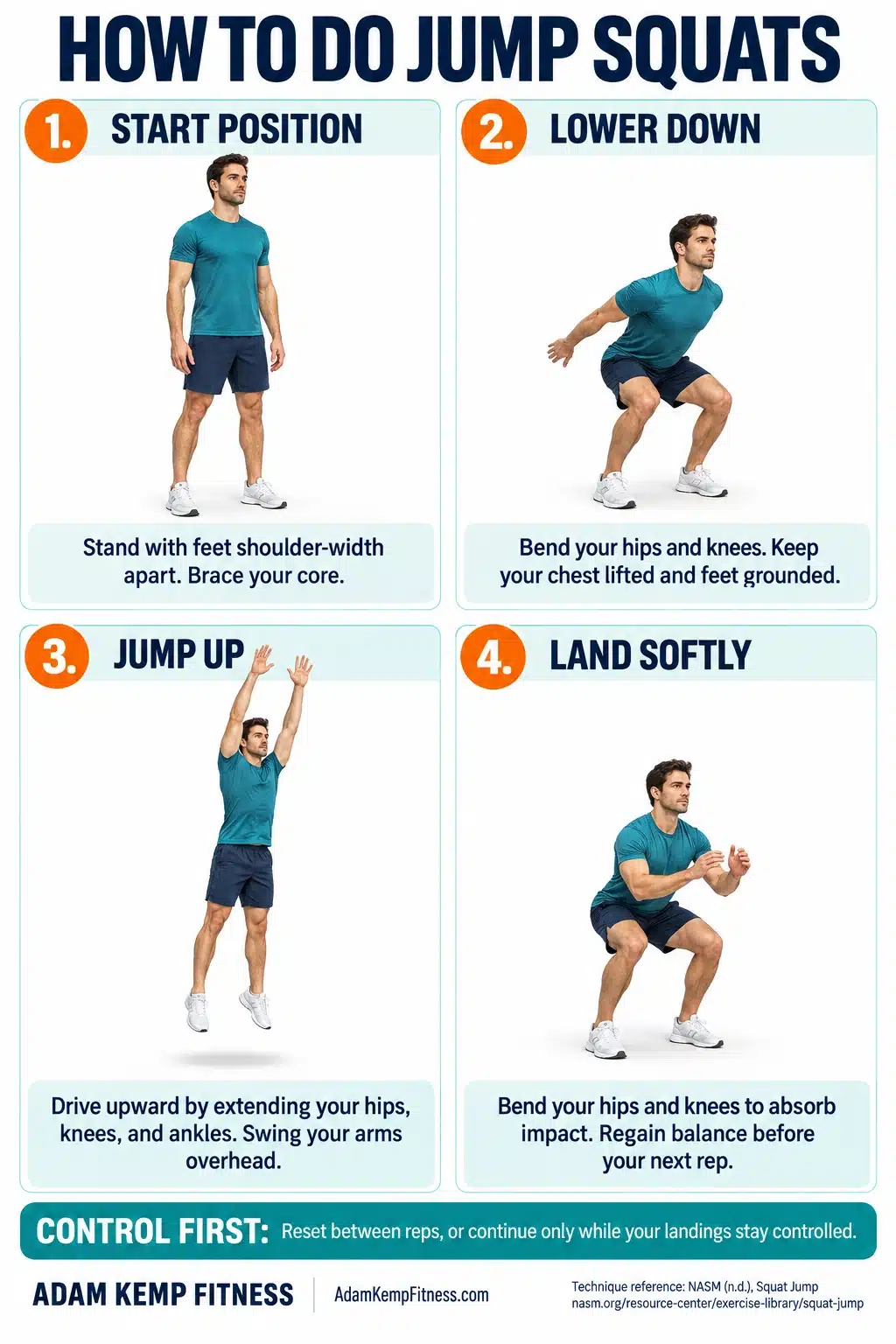
To maximize the benefits of jump squats, follow these steps:
- Start Position: Stand with your feet shoulder-width apart.
- Lower Down: Squat by bending at the hips and knees while keeping your chest upright and core engaged.
- Explosive Jump: Push through your heels and jump as high as possible, extending your arms overhead.
- Soft Landing: Land gently, bending your knees to absorb the impact, and immediately transition into the next rep.
How Much Weight Should You Use for Jump Squats?
Proper form and technique are crucial for jump squats to prevent injury and maximize the exercise’s benefits.
One of the most important considerations is selecting the right weight to optimize performance.
The Case for Light or Bodyweight Jump Squats
A lesser-known yet critical aspect of jump squats is keeping the weight light and emphasizing speed.
Research has shown that adding too much weight can reduce power output, negating the explosive benefits of the exercise.
A study published in Sports Biomechanics found that system power output and joint power at the knee and ankle joints were maximized at 0% of one-rep max (1-RM).
As weights increased, power output diminished significantly, leading researchers to conclude that power is best optimized with bodyweight or very light resistance.
Light weights or bodyweight-only jump squats allow you to focus on speed and explosiveness—the core elements of this exercise.
By moving quickly through the upward phase, you train your fast-twitch muscle fibers more effectively, which directly impacts athletic performance.
This approach also minimizes strain on your joints, making jump squats accessible to a broader range of fitness levels.
Weighted Jump Squats: A Strategic Addition
While heavy resistance isn’t recommended for jump squats, light weights can provide additional benefits when used strategically.
Weighted jump squats can:
- Enhance eccentric control during landing.
- Improve muscle endurance by increasing time under tension.
- Target stabilizing muscles for greater joint stability.
However, bodyweight jump squats remain one of the most effective and versatile exercises in any fitness routine.
They require no equipment, can be performed anywhere, and still deliver tremendous benefits for power, strength, and coordination.
For most individuals, focusing on bodyweight or very light weights ensures optimal results without compromising technique or safety.
Dumbbell or Kettlebell vs. Barbell vs. Trap Bar Jump Squats
You can perform weighted jump squats with a trap bar, dumbbells, kettlebells, or a barbell, but where you hold the weight changes the exercise.
Research shows that load placement can influence jump height, force production, and power output, making equipment selection more than a matter of convenience (Swinton et al., 2012).
For practical training, I prioritize the trap bar for adjustable loading, kettlebells for versatility, and dumbbells for simplicity.
Barbell jump squats are another effective option, but they require more careful management of the weight during takeoff and landing.
Trap Bar Jump Squats
The trap bar is my first choice for progressively loading jump squats.
You can adjust resistance with plates and hold the handles beside your body without lifting a weight into a goblet position or placing a bar across your shoulders.
This setup makes the trap bar especially convenient once you are ready for loaded jumps, though the empty bar may already be too heavy for some beginners. Include its weight when calculating your total resistance.
Research supports this loading position: in 29 resistance-trained rugby players, hexagonal-bar jumps produced greater jump height, peak force, peak power, and peak rate of force development than jumps performed with a straight barbell across the shoulders (Swinton et al., 2012).
Another study involving 17 professional rugby players found that peak power during trap bar jump squats was optimized at 10–20% of box-squat one-repetition maximum (Turner et al., 2015).
Subscribe to my YouTube channel for more practical strength and power training advice, and watch my trap bar deadlift video for a demonstration of the foundational lift. Become comfortable handling the implement before progressing to jumping with it.
Kettlebell Jump Squats
Kettlebells offer several convenient ways to change the loading position.
You can hold one kettlebell in front of your body with both hands, or use two smaller kettlebells at your sides, like dumbbells.
A centered goblet hold places the resistance in front of your torso, while two side-held kettlebells distribute it beside your body.
These positions create different balance and weight-control demands, although neither should automatically be considered superior for power development.
I like this flexibility because you can change the setup between sets depending on the available weights, your comfort, and the stimulus you want.
Keep the kettlebells controlled, leave clearance around your legs, and reposition them only after stopping.
Dumbbell Jump Squats
Dumbbell jump squats are a classic, straightforward way to add resistance.
Hold a matched pair at your sides, keep your arms long, and perform controlled jumps without swinging or curling the weights.
They are especially convenient when you want a lighter load than an empty trap bar provides.
Choose dumbbells that allow comfortable clearance beside your legs and let you maintain a secure grip throughout each repetition.
For a simple gym setup, dumbbells are an easy option: select your weights, establish your stance, and focus on consistent takeoffs and landings.
Barbell Jump Squats
Barbell jump squats can serve as a lower-body power exercise, but they are my last choice among these options.
With the bar resting on your upper back, you must control the shoulder-supported load throughout the jump and landing.
My concern is the added demand of absorbing a landing while resisting through the torso, especially if the bar shifts or your position deteriorates.
For most readers, I would start with controlled bodyweight jumps, then choose a manageable dumbbell, kettlebell, or trap-bar variation.
Reserve barbell jump squats for experienced lifters with appropriate coaching and a clear reason to use that setup.
Frequently Asked Questions About Jump Squats
Final Thoughts: Are Jump Squats a Good Exercise for You?
The benefits of jump squats make them worth considering for your workout program if your goals include developing explosive leg power and improving athletic performance.
Research suggests that structured jump squat training can improve jumping ability, strength, and sprint performance, although results depend on your starting point and training program (Vanderka et al., 2016).
My recommendation is to begin with bodyweight repetitions and prioritize controlled landings before adding resistance.
Choose a variation that matches your ability, and finish each set before fatigue noticeably reduces your jump height or movement quality.
For a balanced workout program, pair jump squats with strength exercises and use activities such as the prowler sled exercise or Jacob’s Ladder exercise in a separate conditioning block.
Getting the most from the benefits of jump squats means choosing quality, consistency, and appropriate progression over quantity and intensity.
Watch my jump squat video for demonstrations, and please subscribe to my YouTube channel for more practical training advice from my experience as a professional basketball player.
This website does not provide medical advice. This website site does contain affiliate links, and purchases may earn a commission.
Read my Medical Disclaimer, Review Disclaimer, and Publishing Policies for more details. Use of this site indicates acceptance of these terms.