What are SMART Goals & How Can SMART Goals Help You?
 Reading Time: 14 minutes
 Goal setting is a key factor that separates mediocre results from outstanding success, and as a professional athlete, I can honestly say I have relied on SMART goals as the foundation of my success in both my personal and career development.
I use this structured approach not only for myself but also with my teams and even in my family life.
SMART goals provide clarity, keeping my mind organized and focused while allowing me the freedom to take action with confidence.
When I create. SMART goal- I know there is a clear plan and a defined objective, and I can move forward without hesitation.
One of the greatest advantages of SMART goals is their flexibility.
I create weekly, monthly, and yearly SMART goalsto stay on track, and I also apply this framework to specific meetings or discussions so that everyone I work with is on the same page.
This approach makes planning simple, effective, and motivating, ensuring that every step taken is a step closer to success.
If you want to take control of your progress and stay motivated every step of the way, SMART goals can be your ultimate game-changer.
Keep reading to learn exactly how to use this powerful framework to achieve your dream body, get healthier, maximize your potential, and create lasting success in any area of your life!
What Are SMART Goals?
SMART goals provide a structured and proven method for setting clear, actionable objectives that keep you focused, motivated, and on track for success.
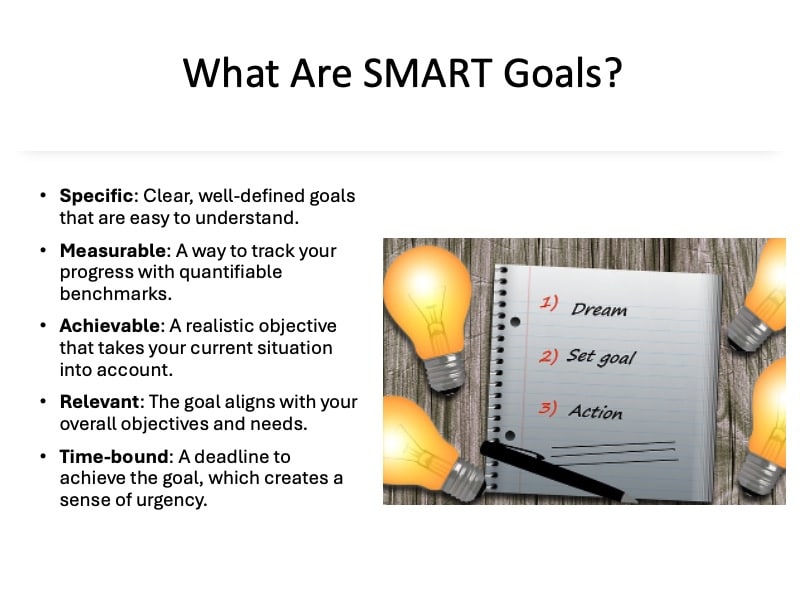
SMART is an acronym that stands for Specific, Measurable, Achievable, Relevant, and Time-bound.
This goal-setting framework provides an organized approach to help individuals set clear, definable objectives and is used by athletes, business leaders, and many others worldwide (Doran, 1981).
- Specific: Clear, well-defined goals that are easy to understand.
- Measurable: A way to track your progress with quantifiable benchmarks.
- Achievable: A realistic objective that takes your current situation into account.
- Relevant: The goal aligns with your overall objectives and needs.
- Time-bound: A deadline for achieving the goal, creating a sense of urgency.
Characteristics of a Strong SMART Goal: A Checklist and Common Mistakes
A strong SMART goal is clear enough to guide action and practical enough to fit your circumstances. Before committing to a target, check whether its wording tells you what to do and gives you a fair way to evaluate progress.
Use these five questions as a final checklist:
- Specific: What action or result am I committing to?
- Measurable: What will I record to assess progress?
- Achievable: Does this fit my starting point, resources, and schedule?
- Relevant: Which personal priority does this support?
- Time-bound: When will I complete or review the commitment?
Consider the difference between “I will get fit soon” and “For the next four weeks, I will complete two planned 20-minute workouts each week and record them in my calendar to establish a consistent routine.”
The second statement gives you a behavior, a measurement, a purpose, and a timeframe. Whether it is achievable still depends on your circumstances.
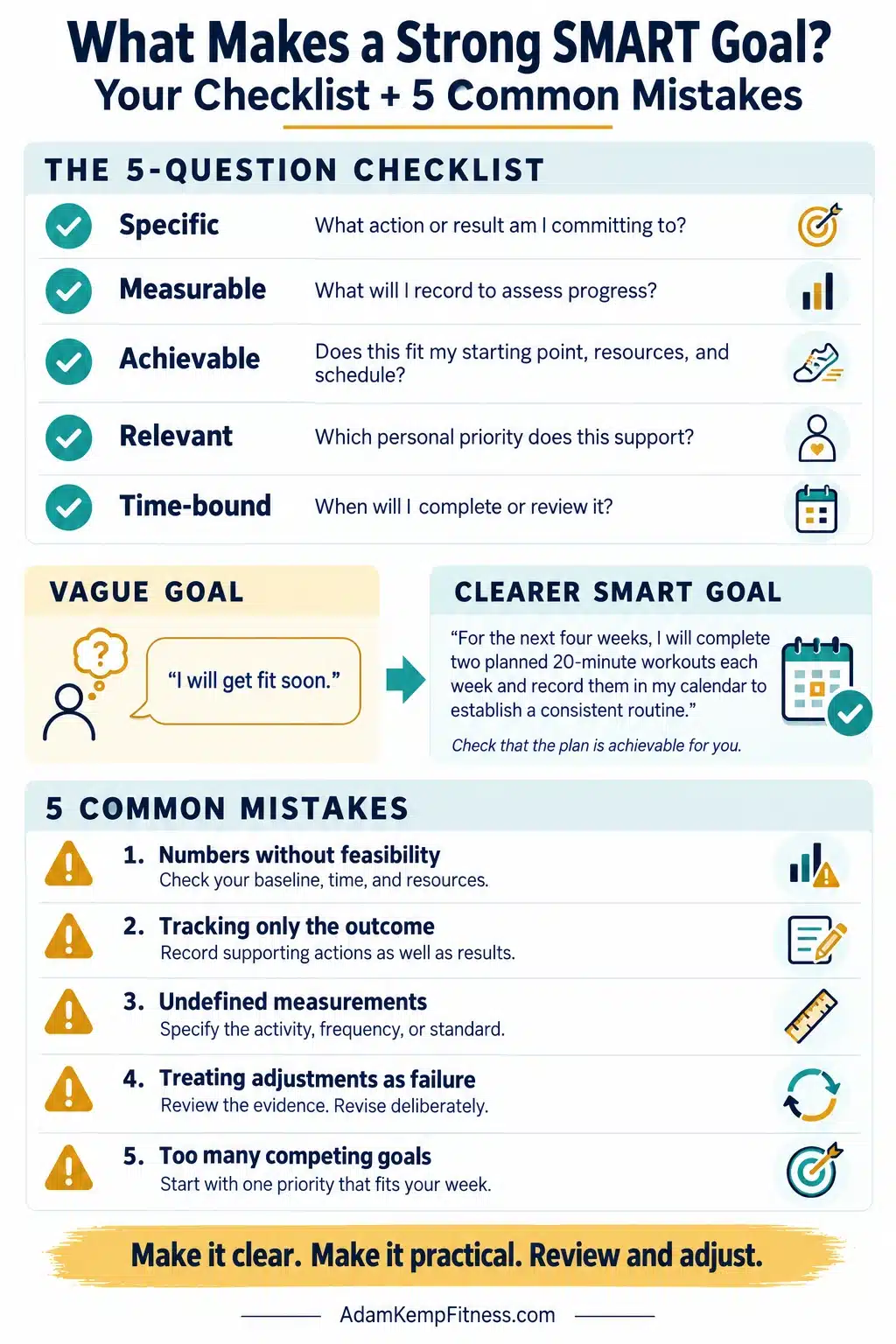
Mistake 1: Using Numbers Without Checking Feasibility
Adding a number and deadline does not automatically make a goal appropriate. A target can be precise while requiring time, skills, or resources you do not currently have.
Before committing, compare it with your baseline and identify what would need to change for the plan to work.
Mistake 2: Measuring Only the Final Outcome
A goal such as reaching a performance benchmark needs supporting actions.
If you record only the final result, your notes will not show whether you completed the planned practice.
Track the relevant behavior alongside the outcome so your review can distinguish between following the plan and getting the expected result.
Mistake 3: Leaving Measurement Undefined
“Practice regularly” and “eat healthier” allow too much room for interpretation.
Define the activity, frequency, or observable standard before you begin.
For example, specify completed practice sessions rather than relying on whether you felt productive that week.
Mistake 4: Treating Every Adjustment as Failure
A deadline provides a point for evaluation. If your circumstances change or the original target proves unsuitable, review the evidence and revise it deliberately.
Write down what changed and why, so adjustment remains a considered decision.
Mistake 5: Creating Too Many Competing Goals
Check the combined time required by your goals, not just whether each looks reasonable on its own.
A workout plan, meal-preparation routine, and study schedule all draw from the same week.
My suggestion is to begin with one priority you can clearly schedule and evaluate. Add another when you understand how the first fits your life.
Why Are SMART Goals Effective?
SMART goals tap into psychological and behavioral constructs that promote success.
They provide structure and direction, increasing motivation and commitment (Locke & Latham, 2002).
Specificity helps you to focus your efforts, measurability allows for tracking and adjustment, and having achievable and relevant goals ensures that your efforts are neither too lax nor overwhelming.
The time-bound nature creates a sense of urgency, further driving your efforts toward achievement.
Together, these elements build a strong foundation for sustained effort and successful outcomes.
How to Write SMART Goals: A Simple Fill-in-the-Blank Template
To write SMART goals, identify one priority, choose a measurable action or outcome, and give it a realistic timeframe. Then explain why it matters and decide how you will record progress.
You do not need an elaborate statement. Start with this fill-in-the-blank SMART goal template:
“For the next [time period], I will [specific action] [frequency or amount] to support [personal priority]. I will track my progress using [measurement method] and review it on [date].”
For example: “For the next four weeks, I will prepare lunch at home every Sunday for Monday through Wednesday to make weekday meals more organized. I will record the lunches prepared in my planner and review the routine at the end of week four.”
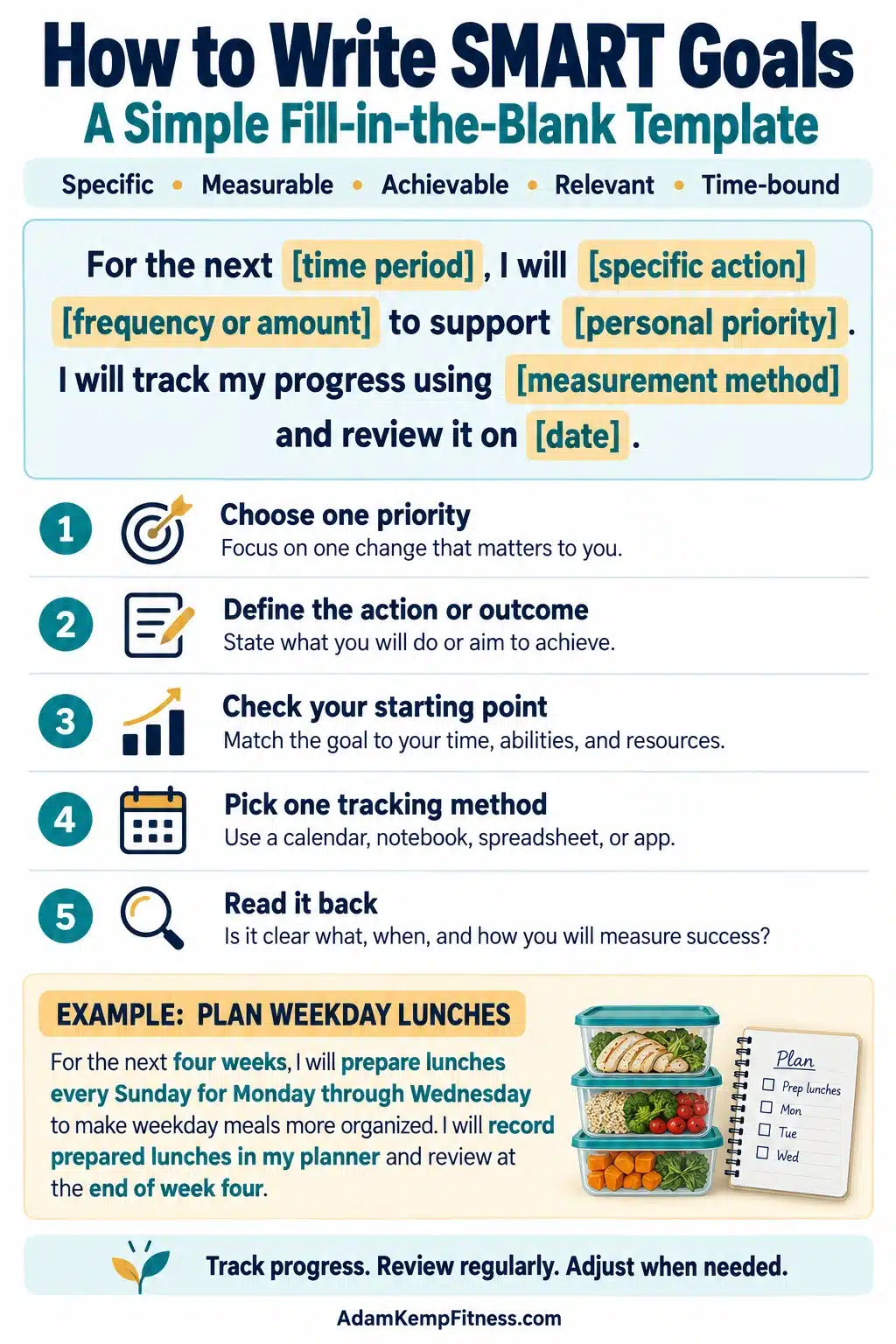
Start With One Clear Priority
Before completing the template, finish this sentence: “The change I want to focus on right now is…”
Choose something narrow enough to act on. “Improve my whole lifestyle” needs several decisions, while “plan my weekday lunches” identifies a specific starting point.
Choose an Action or an Outcome
An action goal describes a behavior you intend to perform, such as completing two scheduled workouts each week.
An outcome goal describes a result, such as reaching a particular performance benchmark.
You can use both, but distinguish them. Completing your planned training and achieving a performance improvement are separate things to measure.
Check Your Baseline and Resources
Ask whether the target fits your starting point, available time, equipment, and other responsibilities.
If the lunch example requires containers, groceries, and preparation time, put those arrangements into your plan.
“Achievable” should reflect that practical check, rather than simply being a label you attach to an ambitious target.
Decide Where Progress Will Be Recorded
Choose one tracking method you can use consistently, whether that is a calendar, notebook, spreadsheet, or app.
A meta-analysis of 138 studies found that interventions promoting progress monitoring improved goal attainment on average (Harkin et al., 2016).
For the lunch goal, a weekly count of prepared meals is enough; you do not need to measure every aspect of your diet.
Read the Finished Goal Back
Could someone else understand what you intend to do, when you will do it, and how you will know whether you followed through?
If any part is unclear, revise it before starting. Your SMART goal should function as a usable instruction for your week, with a review date that gives you an opportunity to learn and adjust.
How to Set SMART Goals that Actually Work
Although it may sound intuitive, setting SMART goals takes time and effort because crafting a perfect SMART goal is far more effective than a “good” one.
Here are some tips that will help you craft your first SMART goal:
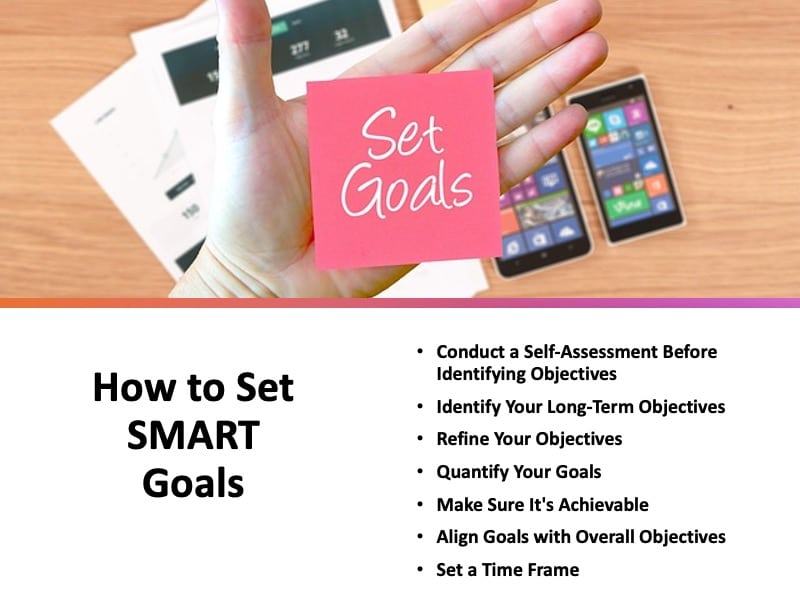
Conduct a Self-Assessment Before Identifying Objectives
Before zeroing in on your long-term objectives, conducting a self-assessment is beneficial.
This could involve tracking your current fitness level, diet habits, and other health-related metrics.
Your baseline data will not only guide the specificity of your SMART goals but also make them more personalized and, consequently, more achievable.
Identify Your Long-Term Objectives
Before setting a specific SMART goal, it’s crucial to identify your long-term objectives.
Are you looking to shed some pounds, improve athletic performance, or perhaps gain muscle mass?
Your overarching goal will determine your specific SMART goals.
Refine Your Objectives: Get into the Specifics
The power of SMART goals lies in their specificity.
Instead of settling for a vague aspiration like “I want to lose weight,” separate this desire into quantifiable metrics.
For example, say, “I aim to lose 10 pounds and reduce my body fat by 2% in the next 3 months by combining cardiovascular exercise with strength training and a balanced diet.”
This level of detail serves as a tangible roadmap for your journey.
Quantify Your Goals
Next, your goals need to be measurable.
For weight loss, the measurement is relatively straightforward: pounds lost, or body mass index (BMI) reduced.
But for something like athletic performance, measurements might include race times or weightlifting amounts.
Remember, your goals’ “measurable” aspect will vary based on what you’re trying to achieve.
While weight loss can be measured in pounds or body mass index (BMI), athletic performance might focus on time shaved off a sprint or the percentage of free throws made in basketball.
If your goal pertains to mental well-being, consider using a validated questionnaire like the Generalized Anxiety Disorder 7-item (GAD-7) scale.
Measurements need to be relevant to your specific objective to provide actionable feedback.
Make Sure It’s Achievable
Aiming high is admirable, but impractical goals can lead to demotivation.
Cross-reference your objectives with your self-assessment and consider constraints such as time, work commitments, or physical limitations.
For instance, if you have never run more than a mile, aiming to complete a marathon in a month is unrealistic.
Your goals should be challenging but within the realm of possibility.
Align Goals with Overall Objectives
Your SMART goals shouldn’t just be achievable and time-bound; they should resonate with your overall objectives and even your life values.
For a professional athlete, a goal related to a specific skill development may have a higher relevance not only in achieving athletic performance but also in building a fulfilling career.
Set a Time Frame
Every SMART goal needs a deadline.
Having a timeframe isn’t just about instilling urgency; it also acts as a lifeline to recalibrate your strategies if you fall behind.
Ensure your deadline is neither too lenient nor too stringent but offers a balanced window that serves as a challenge and a feasible target.
SMART Goals Examples for Fitness, Nutrition, and Personal Growth
Useful SMART goals examples show how to turn a broad intention into a specific commitment. The examples below are starting points to adapt to your abilities, priorities, and schedule, rather than targets everyone should follow.
1.) Build a Consistent Exercise Routine
General goal: “I want to work out more.”
SMART goal: “For the next six weeks, I will complete a 30-minute workout on Tuesday and Saturday, recording each session in my training journal to establish a regular exercise routine.”
This example measures attendance and duration. It doesn’t require a specific change in weight or appearance to count as complete.
2.) Organize Weekday Meals
General goal: “I want to eat better.”
SMART goal: “For the next month, I will write a dinner plan and grocery list every Sunday for four weekday meals to reduce last-minute meal decisions.”
This makes meal planning the immediate target. You can decide separately which foods and recipes fit your needs.
3.) Include Vegetables More Consistently
General goal: “I should eat more vegetables.”
SMART goal: “For the next four weeks, I will include one serving of vegetables with dinner at least five nights each week and mark completed days on my kitchen calendar.”
Choose a serving definition before starting, such as one cup of a particular vegetable, so your tracking stays consistent.
4.) Create an Evening Wind-Down Routine
General goal: “I want a better bedtime routine.”
SMART goal: “For the next three weeks, I will put my phone away at 9:30 p.m. on five evenings each week and spend 15 minutes reading before bed.”
This measures the routine you follow, without guaranteeing you will fall asleep at an exact time.
5.) Make Time for Personal Learning
General goal: “I want to learn more about nutrition.”
SMART goal: “Over the next four weeks, I will read one chapter of my chosen nutrition textbook each Sunday and write three takeaways in a notebook.”
When choosing among these personal goal examples, begin with the one that addresses your current priority. Make the commitment small enough to fit your circumstances, then use your review date to decide what should come next.
How to Stay Committed to Your SMART Goals
Once you’ve set your SMART goals, the next challenge is to stay committed.
Commitment is not just a one-time decision but a continuous process.
Here are some proven methods to maintain your focus and dedication:
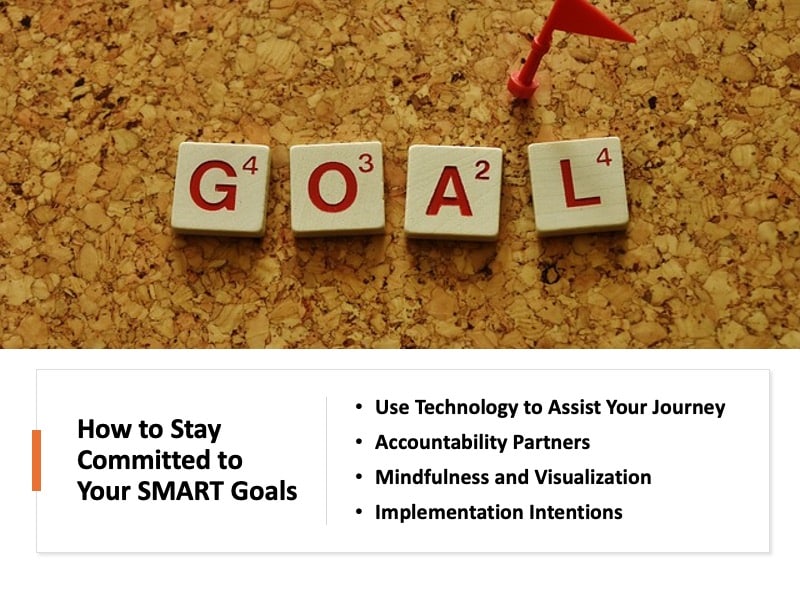
Use Available Technology
There are numerous apps available that can track your health metrics, workout progress, or nutrition intake.
Apps like MyFitnessPal for diet and Strava for exercise can serve as excellent companions on your journey to health and fitness, providing measurable data that you can cross-reference with your goals.
Get an Accountability Partner
Studies show that having an accountability partner can significantly boost your success in meeting your goals (Lally & Gardner, 2013).
Whether it’s a gym buddy or a family member invested in your success, sharing your SMART goals can offer an extra layer of commitment.
Mindfulness and Visualization
Psychological strategies such as mindfulness and visualization can also be effective.
Mindfulness can help you become more aware of your actions and choices, making it easier to stick to your plan.
Visualization techniques involve imagining accomplishing your goals, which can serve as a mental motivator (Taylor et al., 1998).
Implementation Intentions: A Psychological Lever for Success
One of the reasons why people often fail to achieve their SMART goals is the gap between intention and action.
Here is where “implementation intentions” can play a pivotal role.
An implementation intention is a self-regulatory strategy that helps translate your goals into action.
It usually takes the form of an “if-then” plan:
“If situation X arises, then I will perform response Y” (Gollwitzer, 1999).
Creating Your If-Then Plans
To create an effective implementation intention, identify the challenges or obstacles that may hinder your progress toward your SMART goals.
For example, if your goal is to exercise more, a challenge could be the temptation to skip the gym after a tiring workday.
Your “if-then” plan might be: “If I feel tired after work, then I will do a 20-minute home workout instead of skipping exercise.”
The Power of Automaticity
The beauty of implementation intentions is that they help automate your responses.
By pre-deciding what to do in challenging situations, you reduce the mental effort required to make decisions, making it more likely you’ll stick to your goals (Webb & Sheeran, 2008).
Consistency and Adaptation
Consistency is important for achieving nearly any goal in life, and consistency is key when employing implementation intentions.
Keep your “if-then” plans straightforward and actionable.
However, be willing to adapt these plans as you learn more about what works for you and as your situation changes.
By incorporating implementation intentions into your SMART goals framework, you further bridge the gap between intention and action, making it more likely that you’ll achieve the health and fitness results you desire.
How to Assess and Adjust SMART Goals Over Time
A SMART goal is not set in stone.
The Time-bound aspect serves as a checkpoint, not an endpoint.
It’s essential to assess your progress as you go, especially when you reach your initially set timeframe.
Review and Reflect
At the end of your timeframe, take a step back to review what you’ve accomplished.
Have you met, exceeded, or fallen short of your goal?
Use this reflection period to adjust your strategies or set new SMART goals.
Dealing with Changes
Life is unpredictable, and circumstances can change.
Whether it’s a change in your work schedule, a sudden illness, or newfound knowledge about your health, it’s important to revisit and modify your goals accordingly.
Celebrate and Move Forward
If you’ve achieved your goal, take the time to celebrate.
Rewards, even small ones, can serve as strong motivational tools.
For example, non-food fitness rewards are especially effective because they reinforce a sense of accomplishment without undermining the development of healthy habits, helping individuals strengthen positive behavior patterns and avoid reward cycles that rely on food as a treat.
Then, think about the next steps.
Are there higher mountains to climb or different terrains to explore?
By implementing these strategies for maintaining commitment and assessing and adjusting your goals, you’ll be better equipped to navigate the complexities of health and fitness improvements.
Final Thoughts: How to Use SMART Goals to Achieve Your Dreams!
Reaching your biggest goals, whether in health, fitness, career, or personal growth, isn’t just about effort; it’s about having a clear and effective plan.
By using the SMART goals framework, you transform aspirations into specific, measurable, achievable, relevant, and time-bound objectives that guide your progress.
This structured approach keeps you focused, motivated, and accountable, ensuring that you’re consistently moving forward.
When you incorporate strategies like implementation intentions and periodic assessments, you create a roadmap for long-term success rather than relying on short bursts of motivation.
But remember, goal setting is an ongoing process.
Regularly evaluating your progress, refining your approach, and making necessary adjustments keeps you on track and prevents you from feeling stuck.
The beauty of SMART goals is that they apply to every area of life. Whether you’re working toward better health, improving your fitness, advancing in your career, or building stronger relationships, this method provides clarity and direction to help you achieve what matters most.
Each goal you accomplish sets the stage for your next achievement. So start today, set SMART goals that inspire you, challenge you, and move you closer to the life you truly want.
This website does not provide medical advice. This website site does contain affiliate links, and purchases may earn a commission.
Read my Medical Disclaimer, Review Disclaimer, and Publishing Policies for more details. Use of this site indicates acceptance of these terms.
Check Out Some of My YouTube Videos Below, and Please Follow on YouTube for More Educational Health and Fitness Content!
![Subscribe to @AdamKempFitness for more training, general health, recovery, and nutrition tips from a professional basketball player with a master’s degree in Nutrition Education! 🏀💪
Seated Max Vertical Jumps From a Box are one way I train explosive takeoff power with maximum intent on every rep.
Starting seated, with a pause and minimal rocking or dipping, reduces the contribution of a quick countermovement and emphasizes producing force from a relatively static position (National Strength and Conditioning Association [NSCA], 2020).
For athletes, the training goal is explosive lower-body force production and coordinated extension through the hips, knees, and ankles. I use this variation to practice driving hard into the floor and accelerating my body upward.
My preferred setup: 3 sets of 3 reps or 4 sets of 2 reps, supersetted with a strength or power exercise.
I keep the reps low, reset between jumps, and take longer rest periods so I’m ready to attack every takeoff. Even when pairing exercises, I give myself enough recovery to keep the jumps sharp.
Every rep has one goal: jump as high as possible. I focus on an explosive takeoff, a controlled landing, and consistent quality throughout the session.
Save this for your next power workout! 🚀
Reference: NSCA. (2020). Stretch-shortening cycle.
#VerticalJump #JumpTraining #ExplosivePower #AthleticPerformance #BasketballTraining](https://www.adamkempfitness.com/wp-content/plugins/feeds-for-youtube/img/placeholder.png)