Compression Socks for Recovery: What the Research Shows
 Reading Time: 5 minutes
Wearing compression socks for recovery may offer modest benefits after exercise, but the evidence suggest that promises of fresher legs and faster muscle repair may not be exactly true.
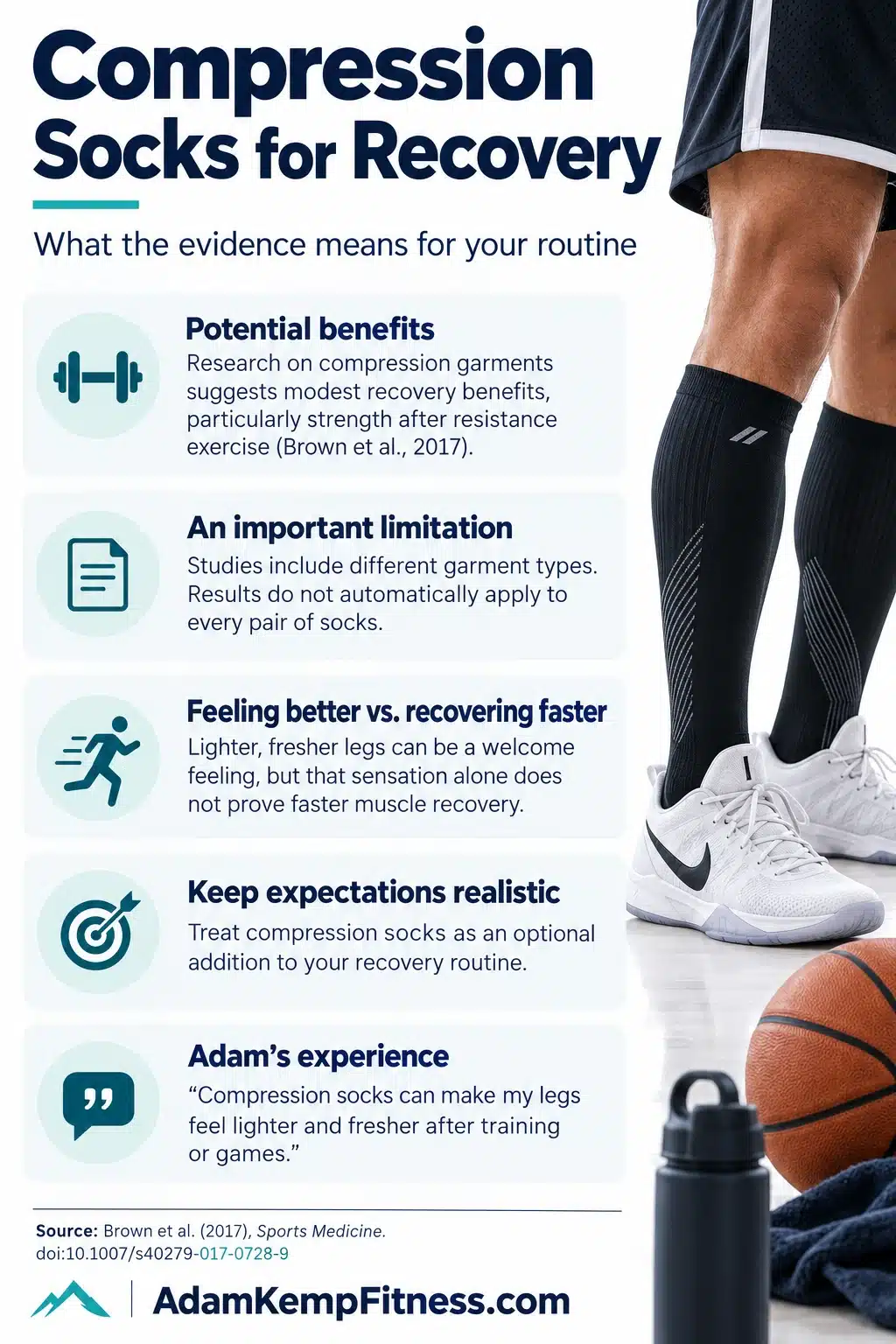
For example, a meta-analysis of 23 studies found that compression garments supported recovery, particularly the return of strength after resistance exercise, although the findings covered several garment types rather than socks alone (Brown et al., 2017).
That distinction matters because results from compression tights or other garments do not automatically apply to every pair of knee-high socks.
In my experience, compression socks for recovery can definitely make my legs feel “lighter” and fresher, and while I’m still unsure whether that feeling translates into faster muscle recovery, I’ve found them helpful when that’s the feeling I’m looking for.
However, the practical question is how much a particular pair might help you recover between workouts, rather than whether compression “works” in every situation.
After more than a decade in professional basketball, I’ve learned to evaluate muscle recovery tools by how well they help me feel and prepare for the next practice or game, especially during busy training and travel stretches.
For your needs, combining that practical perspective with the research can help you decide whether compression socks for recovery are worth adding to your routine and what benefits you can reasonably expect.
What Are Compression Socks?
Compression socks are specially designed socks that apply pressure to your feet and lower legs to support blood flow back toward the heart and help limit fluid buildup.
Unlike ordinary socks, they provide targeted compression that can reduce swelling and discomfort from blood pooling in the legs (Cleveland Clinic, 2026).
Graduated compression socks apply the greatest pressure around the ankle, with pressure gradually decreasing farther up the leg.
Their compression level is measured in millimeters of mercury (mmHg), with higher numbers indicating firmer pressure.
For athletes, compression socks for recovery are one way to explore whether that added support makes the legs feel more comfortable after exercise.
However, supporting circulation and feeling less heaviness are different outcomes from restoring muscle strength or improving performance before your next workout.
How Graduated Compression Works
Graduated compression socks squeeze hardest at the ankle and ease off as they move up the calf.
That gradient is meant to help blood in your lower legs travel back toward the heart rather than pooling around your feet.
Pressure is measured in millimeters of mercury, or mmHg.
According to the Cleveland Clinic, common levels range from mild (8 to 15 mmHg) to moderate (15 to 20 mmHg) to firm (20 to 30 mmHg).
Extra-firm, medical-grade socks at 30 to 40 mmHg usually require a prescription.
For most active people, the moderate 15 to 20 mmHg range is the usual place to start. Firmer is not automatically better, and a sock that is too tight can cause problems of its own.
What the Evidence Says About Compression Socks for Recovery After Exercise
The most cited analysis on this question is a 2017 meta-analysis in Sports Medicine (Brown et al., 2017).
Researchers pooled 23 studies of healthy participants who wore compression garments after training.
Overall, they found small benefits for recovery.
The clearest effect was on strength recovery, especially after resistance training and into the following day.
The authors also recommended compression to support next-day cycling performance.
However, there are limits.
The researchers said the role of pressure level and training status was unclear, partly because many studies did not report enough data.
In practice, compression is a reasonable add-on after a hard session, but it does not replace sleep, nutrition, or a sensible training plan as the basis of exercise recovery.
Comfort also affects whether you wear them at all.
A pair that feels fine on the couch after a lift may feel different during a full workday, which is a separate question.
Are Compression Socks Good for Long Shifts on Your Feet?
Recovery after training is one use. Long hours of standing and walking at work is another, and it affects plenty of people in sports medicine.
Athletic trainers, physical therapists, nurses, and coaches often log 10 to 12 hours on hard floors or turf. By the end of the shift, heavy, achy legs are a common complaint.
A Cochrane review on standing workers found some evidence that compression stockings eased leg fatigue and aching.
The evidence is weak, though, as it rests on one very small trial of 19 flight attendants, so the findings are a starting point rather than a settled answer.
If you want to try compression for workdays, look for socks designed for long shifts rather than race day. Dr. Woof, a brand started by a family of doctors who worked hospital shifts, makes graduated 15-20 mmHg bamboo compression socks for clinicians.
Their range comes in crew, knee-high, and ankle heights, with a separate wide-calf line.
Socks like these work under scrubs or training gear, so the same pair can carry you from clinic to the gym.
How to Choose and Wear Compression Socks Safely
Size by measurement, not shoe size alone.
Measure your ankle and the widest part of your calf, ideally in the morning, and use the brand’s size chart.
Pick a height that suits your day. Knee-high socks cover the full calf, crew socks stop at mid-calf, and ankle styles sit lowest.
Start with moderate compression unless a clinician recommends otherwise.
Put the socks on in the morning and take them off before bed, since Cleveland Clinic advises against sleeping in them.
Some people should check with a healthcare provider first.
That includes anyone with peripheral artery disease, nerve damage that dulls feeling in the legs, open wounds, or severe swelling.
Remove them and call your provider if you notice numbness, tingling, pain, or changes in the skin.
Fabric matters over a long day.
Bamboo-derived rayon and merino blends usually feel softer and more breathable, while nylon-heavy knits tend to be thinner and slicker.
Look for moisture-wicking fabric, a cushioned footbed, and a leg without seams that dig in.
Those details decide whether you still notice the socks at hour 11.
The Bottom Line: Are Compression Socks Good for Recovery?
Wearing compression socks for recovery is a reasonable option if they make your legs more comfortable after exercise, but their benefits should be viewed in perspective.
Research on compression garments suggests modest improvements in recovery, particularly strength recovery after resistance exercise, although those findings do not establish that every type of compression sock provides the same benefits (Brown et al., 2017).
From my experience, compression socks can definitely make my legs feel lighter and fresher after training or games.
I appreciate that feeling, even though I cannot tell from that sensation alone whether my muscles are actually recovering faster.
My approach is to treat them as an optional addition to a recovery routine built around sleep, adequate nutrition, and appropriate training.
If you enjoy wearing them and notice a difference in how your legs feel, that is a reasonable reason to use compression socks for recovery, without expecting them to transform your recovery on their own.
This website does not provide medical advice. This website site does contain affiliate links, and purchases may earn a commission.
Read my Medical Disclaimer, Review Disclaimer, and Publishing Policies for more details. Use of this site indicates acceptance of these terms.
Check Out Some of My YouTube Videos Below, and Please Follow on YouTube for More Educational Health and Fitness Content!